Samsung Galaxy Z Flip8 vs Samsung Galaxy Z Flip7
$100 more for 8 g less and 0.6 mm off the folded thickness, with the Exynos 2600, Android 17 and a published seven-year commitment — the screens, storage, battery capacity and IP48 rating are unchanged.
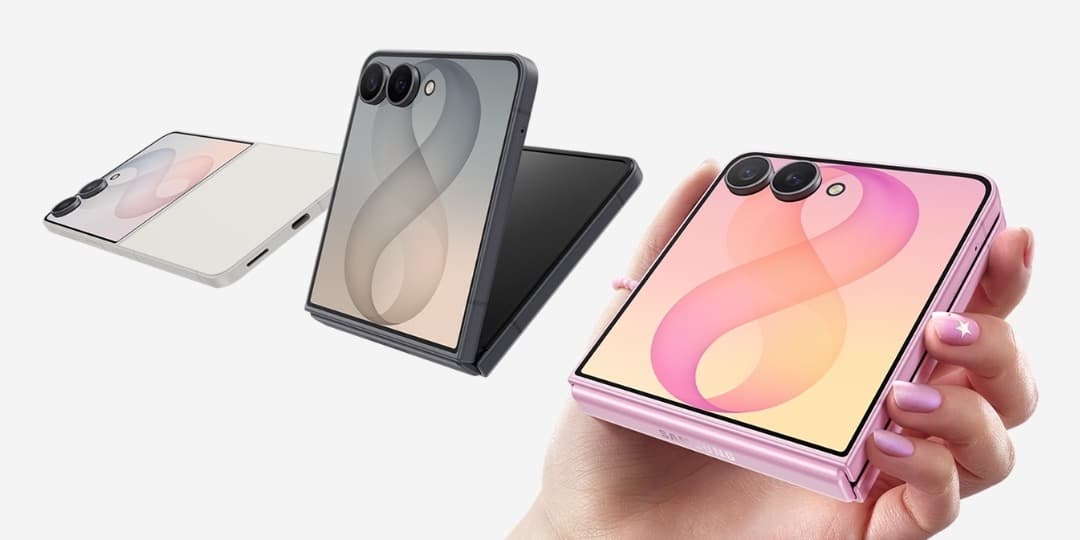
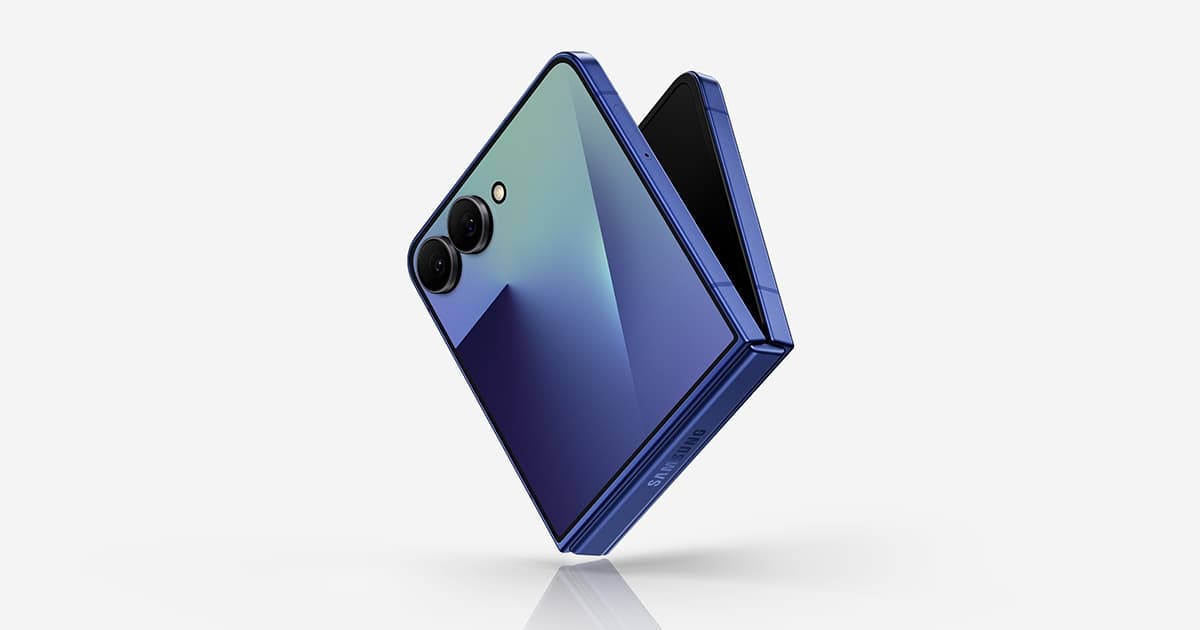
The short version
| Criterion | Samsung Galaxy Z Flip8 | Samsung Galaxy Z Flip7 |
|---|---|---|
| Price | From $1,199.99 (256GB); $1,399.99 at 512GB | From $1,099.99 (256GB); $1,299.99 at 512GB |
| Chip | Exynos 2600 | Exynos 2500 |
| Operating system | Android 17 with One UI 9 | Android 16 with One UI 8 |
| Charging | Up to 55% in around 30 minutes with a 25W adapter and a 3A USB-C cable; Fast Wireless Charging with 15W; Wireless PowerShare | Up to 50% in around 30 minutes with a 25W adapter and a 3A USB-C cable; Fast Wireless Charging 2.0; Wireless PowerShare |
| Size and weight | Folded 85.7 mm tall x 75.4 wide x 13.1 deep; unfolded 166.9 tall x 75.4 wide x 6.1 deep; 180 g | Folded 85.5 mm tall x 75.2 wide x 13.7 deep; unfolded 166.7 tall x 75.2 wide x 6.5 deep; 188 g |
Which one fits
Consider Samsung Galaxy Z Flip8 if
- You want a phone that folds to 85.7 mm tall and 13.1 mm thick
- You want a foldable that weighs 180 g
- You want 55% of a charge in around 30 minutes
Consider Samsung Galaxy Z Flip7 if
- You want a 166.7 mm phone that folds down to 85.5 mm tall
- You want a foldable that weighs 188 g
- You want a foldable that starts at $1,099.99
Main tradeoffs
- 180 g, 13.1 mm folded, Android 17 with One UI 9, and seven generations of OS upgrades with seven years of security updates published$1,199.99, which is $100 more for the same screens, the same storage tiers and the same battery capacity
- $1,099.99 for the same 6.9-inch and 4.1-inch screens, the same 256GB and 512GB tiers and the same 4,300 mAh capacity188 g, 13.7 mm folded, Android 16 with One UI 8, and no published update minimum in the sources we use
At a glance
| Criterion | Samsung Galaxy Z Flip8 | Samsung Galaxy Z Flip7 |
|---|---|---|
| Best for | People who want a normal-size Android phone that folds into a much shorter footprint, and will take two rear cameras to get it | People who want a full-size phone that folds into a much smaller footprint, and will carry 13.7 mm folded to get it |
| Pricing | USD 1199 | USD 1099 |
| Key differentiator | Folds to 85.7 mm tall and 13.1 mm thick at 180 g, with a 4.1-inch cover screen that runs apps and the two rear cameras set inside it | Folds to 85.5 mm tall and 75.2 wide, with a 4.1-inch cover screen that runs apps closed and the two rear cameras set inside it |
| Category | Phones | Phones |
Key facts
| Fact | Samsung Galaxy Z Flip8 | Samsung Galaxy Z Flip7 |
|---|---|---|
| Price | From $1,199.99 (256GB); $1,399.99 at 512GB | From $1,099.99 (256GB); $1,299.99 at 512GB |
| Display | Main 6.9-inch FHD+ Dynamic AMOLED 2X, 2520 x 1080 (tall x wide) at 400 ppi, 120Hz adaptive refresh rate (1-120Hz), Vision Booster; 2,600 nits peak brightness. Samsung measures 6.9 inches as a full rectangle and 6.8 inches accounting for the rounded corners | Main 6.9-inch FHD+ Dynamic AMOLED 2X, 2520 x 1080 (tall x wide), 21:9, 120Hz adaptive refresh rate (1-120Hz); 2,600 nits peak brightness. Samsung measures 6.9 inches as a full rectangle and 6.8 inches accounting for the rounded corners |
| Cover display | 4.1-inch Super AMOLED FlexWindow, 1048 x 948 (tall x wide) at 342 ppi, 60/120Hz refresh rate, Vision Booster. Samsung measures 4.1 inches in the full rectangular form | 4.1-inch Super AMOLED FlexWindow, 1048 x 948 (tall x wide), 60/120Hz refresh rate; 2,600 nits peak brightness. Samsung measures 4.1 inches in the full rectangular form |
| Size and weight | Folded 85.7 mm tall x 75.4 wide x 13.1 deep; unfolded 166.9 tall x 75.4 wide x 6.1 deep; 180 g | Folded 85.5 mm tall x 75.2 wide x 13.7 deep; unfolded 166.7 tall x 75.2 wide x 6.5 deep; 188 g |
| Fold type | Clamshell foldable: folds inward across the short axis, with a cover display on the outside | Clamshell foldable: folds inward across the short axis, with a cover display on the outside |
| Battery life | 4,300 mAh typical dual battery (rated 4,174 mAh) | 4,300 mAh typical dual battery (rated 4,174 mAh); video playback up to 31 hours, Samsung’s estimate against battery capacity using a 720p file saved on the device |
| Chip | Exynos 2600 | Exynos 2500 |
| Camera system | Rear dual camera: 50MP wide-angle (Dual Pixel AF, OIS, F1.8, 1.0 um pixels, 85 degree FOV, 2x optical-quality zoom) and 12MP ultra-wide (F2.2, 1.12 um, 123 degrees); 10MP selfie camera (F2.2, 1.12 um, 85 degrees) | Rear dual camera: 50MP wide-angle (F1.8, Dual Pixel AF, OIS, 1.0 um pixels, 85 degree FOV) and 12MP ultra-wide (F2.2, 1.12 um, 123 degrees); 10MP selfie camera (F2.2, 1.12 um, 85 degrees) |
| Operating system | Android 17 with One UI 9 | Android 16 with One UI 8 |
| Charging | Up to 55% in around 30 minutes with a 25W adapter and a 3A USB-C cable; Fast Wireless Charging with 15W; Wireless PowerShare | Up to 50% in around 30 minutes with a 25W adapter and a 3A USB-C cable; Fast Wireless Charging 2.0; Wireless PowerShare |
| Storage | 256GB and 512GB, both with 12GB of memory; Samsung notes memory options may vary by market | 256GB and 512GB, both with 12GB of memory; Samsung notes memory options may vary by market |
| Software support | Seven generations of OS upgrades and seven years of security updates from the initial global launch date; Samsung notes the timing may vary by device model, network provider and market | — |
| Water resistance | IP48, based on lab test conditions for submersion in up to 1.5 metres of fresh water for up to 30 minutes; Samsung does not advise beach or pool use and notes water resistance is not permanent | IP48, based on lab test conditions for submersion in up to 1.5 metres of fresh water for up to 30 minutes; Samsung does not advise beach or pool use |
One family, one generation apart, and almost nothing moved. Both screens, the storage tiers, the battery capacity, the water resistance and the fold are the same. The Flip8 is 8 g lighter and 0.6 mm thinner folded, runs a newer chip and newer software, and costs $100 more.
Overview
One family, one generation apart, and unlike the two Folds this is not a redesign. The Flip8 and the Flip7 open onto the same 6.9-inch screen, close onto the same 4.1-inch one, carry the same battery capacity, the same storage tiers and the same IP48 rating, and fold the same way. Five things moved, and the question this page answers is whether they are worth $100.
What changed, and what did not
Changed: the price, the chip, the shipped software, the charging claim and the body. Unchanged: both screens, the storage tiers, the battery capacity and the water and dust classification. That is a short list in each column, and it is the honest shape of this comparison — there is no structural difference here to decide on, only a set of increments and a price.
Price
$1,199.99 against $1,099.99 at 256GB, and $1,399.99 against $1,299.99 at 512GB. The gap is $100 at both tiers, which makes this the simplest reading on the page: the Flip8 costs $100 more than the Flip7 whichever configuration you want. Both are Samsung's current list prices, reconfirmed before this page was published, and neither counts trade-in credit, instant savings or financing.
The body
The Flip8 is 180 g against 188, and 13.1 mm thick folded against 13.7 — 8 g and 0.6 mm. Opened it is 6.1 mm against 6.5. It is also fractionally larger in the other two directions: 85.7 mm tall and 75.4 wide folded, against 85.5 and 75.2, and 166.9 mm tall open against 166.7. So it is lighter and thinner but very slightly taller and wider, which is not the same thing as smaller. Two tenths of a millimetre is not something you will notice; 8 g and half a millimetre of thickness in a pocket is closer to being something you might.
The chip and the shipped software
The Flip8 runs an Exynos 2600 and the Flip7 an Exynos 2500. They are two different parts and that is all we will say about them, because Samsung publishes no benchmark the two have both run — any claim about speed here would be ours rather than theirs. The software ships a generation apart: Android 17 with One UI 9 against Android 16 with One UI 8. Both are Android, and the version is the part that differs.
Charging
This is the most directly comparable row on the page, because for once the two claims are made the same way. Samsung quotes up to 55 per cent in around 30 minutes for the Flip8 and up to 50 per cent in around 30 minutes for the Flip7, both with a 25W adapter and a 3A USB-C cable, both from its own lab tests from empty. Same adapter, same window, five percentage points apart. Wireless is stated as 15W on the Flip8 and as Fast Wireless Charging 2.0 on the Flip7, which are different ways of describing it rather than two numbers you can line up; both carry Wireless PowerShare.
What the generation left alone
Worth stating plainly, because it is most of the phone. The main screen is 6.9 inches at 2520 by 1080 on both, Dynamic AMOLED 2X, 1 to 120Hz, 2,600 nits at peak. The cover screen is 4.1 inches at 1048 by 948 on both, 60 to 120Hz. Where the two stored entries differ — the Flip8's prints 400 ppi and Vision Booster, the Flip7's prints 21:9 — the arithmetic closes the gap: 2520 by 1080 is 21:9, and across 6.9 inches it works out at 397 ppi. Storage is 256GB and 512GB with 12GB of memory on both. Both are rated IP48, tested to 1.5 metres of fresh water for up to 30 minutes, with Samsung advising against beach and pool use. And both are clamshells that fold across the short axis. None of that moved.
Battery
The capacity is identical: 4,300 mAh typical on both, rated 4,174 mAh on both. What is not identical is what Samsung published about it. For the Flip7 it states video playback of up to 31 hours, estimated against the capacity using a 720p file on the device. For the Flip8 it publishes no runtime claim we could find. So we cannot tell you the two last the same time, and we are not going to assume it from a matching number on a datasheet: the chip and the software both changed, and those move battery life in ways a capacity figure does not record.
Updates
This one goes in a single direction, and the exact wording matters. Samsung publishes an explicit commitment for the Flip8: seven generations of OS upgrades and seven years of security updates from the initial global launch date, with the timing varying by model, carrier and market. We found no equivalent published minimum for the Flip7 in the official sources we use, so our software support field for it is empty. That is a difference in what has been published, not a measurement of how long either phone will be supported.
Cameras
As far as the published architecture goes, the same on both: a 50MP wide with Dual Pixel autofocus and OIS, a 12MP ultra-wide, and a 10MP selfie camera, with the same apertures and fields of view. The one thing that separates the two entries is that the Flip8's documents a 2x optical-quality zoom from the main sensor and the Flip7's does not mention one. We have left that unresolved rather than calling it a difference: the Flip7's table not printing a zoom claim is not evidence that the phone cannot do it.
Which one may fit you better
Consider the Galaxy Z Flip8 if 8 g and half a millimetre are worth $100 to you, if you want Android 17 with One UI 9 from the box rather than an update to it, or if a written seven-year commitment is part of what you are buying. Consider the Galaxy Z Flip7 if you would rather keep the $100, since you get the same two screens, the same storage tiers and the same battery capacity, and Samsung publishes a 31-hour video-playback figure for it that it does not publish for the Flip8.
Important considerations
This is an incremental generation and the page should not pretend otherwise. If you already own a Flip7, nothing on this list is a reason to replace it. If you are buying either one new, the decision is $100 against 8 g, half a millimetre, a newer chip and a published support commitment — and which of those matters is a personal question rather than a technical one. We are paid nothing on either of these; both links go to Samsung's own store.