Samsung Galaxy Z Fold8 Ultra vs Samsung Galaxy Z Fold8
$200 separates a 201 g Fold8 that opens sideways onto 7.6 inches from a 215 g Ultra with an 8.0-inch inner screen, a 6.5-inch cover and a dedicated 3x telephoto.
The short version
| Criterion | Samsung Galaxy Z Fold8 Ultra | Samsung Galaxy Z Fold8 |
|---|---|---|
| Price | From $2,099.99 (256GB); $2,299.99 at 512GB; $2,699.99 at 1TB | From $1,899.99 (256GB); $2,099.99 at 512GB; $2,499.99 at 1TB |
| Display | Main 8.0-inch QXGA+ Dynamic AMOLED 2X, 2,504 x 2,256 (tall x wide) at 422 ppi, 120Hz adaptive refresh rate (1-120Hz), Vision Booster. Samsung measures 8.0 inches both as a full rectangle and accounting for the rounded corners | Main 7.6-inch QXGA+ Dynamic AMOLED 2X, 1,848 x 2,448 (tall x wide) at 403 ppi, 120Hz adaptive refresh rate (1-120Hz), Vision Booster. Samsung measures 7.6 inches both as a full rectangle and accounting for the rounded corners |
| Cover display | 6.5-inch FHD+ Dynamic AMOLED 2X, 2,520 x 1,080 (tall x wide) at 422 ppi, 120Hz adaptive refresh rate (1-120Hz), Vision Booster. Samsung measures 6.5 inches both as a full rectangle and accounting for the rounded corners | 5.5-inch WUXGA+ Dynamic AMOLED 2X, 1,972 x 1,248 (tall x wide) at 428 ppi, 120Hz adaptive refresh rate (1-120Hz), Vision Booster. Samsung measures 5.5 inches as a full rectangle and 5.4 inches accounting for the rounded corners |
| Camera system | Rear triple camera: 200MP wide-angle (Quad Pixel AF, OIS, F1.7, 0.6 um pixels, 85 degree FOV, 2x optical-quality zoom), 50MP ultra-wide (Quad Pixel AF, F1.9, 0.7 um, 120 degrees) and 10MP telephoto (PDAF, OIS, F2.4, 1.0 um, 36 degrees, 3x optical zoom); 10MP cover selfie camera (F2.2, 1.12 um, 85 degrees); 10MP main-screen camera (F2.2, 1.12 um, 100 degrees) | Rear dual camera: 50MP wide-angle (Dual Pixel AF, OIS, F1.8, 1.0 um pixels, 85 degree FOV, 2x optical-quality zoom) and 50MP ultra-wide (Quad Pixel AF, F1.9, 0.7 um, 120 degrees); 10MP cover selfie camera (F2.2, 1.12 um, 85 degrees); 10MP main-screen camera (F2.2, 1.12 um, 100 degrees) |
| Battery life | 5,000 mAh typical dual battery (rated 4,854 mAh) | 4,800 mAh typical dual battery (rated 4,660 mAh) |
| Charging | Up to 67% in around 30 minutes with a 45W adapter and a 3A USB-C cable; Fast Wireless Charging with 20W; Wireless PowerShare | Up to 63% in around 30 minutes with a 45W adapter and a 3A USB-C cable; Fast Wireless Charging with 20W; Wireless PowerShare |
| Size and weight | Folded 158.4 mm tall x 72.8 wide x 8.9 deep; unfolded 158.4 tall x 143.2 wide x 4.1 deep; 215 g | Folded 123.9 mm tall x 81.9 wide x 9.7 deep; unfolded 123.9 tall x 161.4 wide x 4.5 deep; 201 g |
Which one fits
Consider Samsung Galaxy Z Fold8 Ultra if
- You want an inner screen at 2,504 x 2,256
- You want a 5,000 mAh battery in a book-style foldable
- You want a dedicated telephoto lens alongside a 200MP wide camera
Consider Samsung Galaxy Z Fold8 if
- You want a book-style foldable at $1,899.99 to start
- You want a folded body 123.9 mm tall at 201 g
- You want a 7.6-inch screen that opens sideways rather than upward
Main tradeoffs
- An 8.0-inch inner screen, a 6.5-inch cover screen, a dedicated 3x telephoto and 5,000 mAh of typical capacity$2,099.99 to start, 215 g, and a folded body 158.4 mm tall rather than 123.9
- $1,899.99 to start, 201 g, and a folded body 123.9 mm talla 7.6-inch inner screen, a 5.5-inch cover screen, two rear lenses with no dedicated telephoto, and 4,800 mAh of typical capacity
At a glance
| Criterion | Samsung Galaxy Z Fold8 Ultra | Samsung Galaxy Z Fold8 |
|---|---|---|
| Best for | People who want Samsung’s larger book-style foldable, with a dedicated 3x telephoto and a cover screen they can use all day without opening it | People who want a book-style foldable that opens sideways into a 7.6-inch screen and folds to a 123.9 mm body, inside Samsung’s ecosystem |
| Pricing | USD 2099 | USD 1899 |
| Key differentiator | An 8.0-inch inner screen at 2,504 x 2,256 and a 6.5-inch cover screen, with three rear cameras including a 10MP telephoto at 3x optical zoom | Opens sideways into a 7.6-inch screen from a 123.9 mm body at 201 g, with seven generations of OS upgrades and seven years of security updates published |
| Category | Phones | Phones |
Key facts
| Fact | Samsung Galaxy Z Fold8 Ultra | Samsung Galaxy Z Fold8 |
|---|---|---|
| Price | From $2,099.99 (256GB); $2,299.99 at 512GB; $2,699.99 at 1TB | From $1,899.99 (256GB); $2,099.99 at 512GB; $2,499.99 at 1TB |
| Display | Main 8.0-inch QXGA+ Dynamic AMOLED 2X, 2,504 x 2,256 (tall x wide) at 422 ppi, 120Hz adaptive refresh rate (1-120Hz), Vision Booster. Samsung measures 8.0 inches both as a full rectangle and accounting for the rounded corners | Main 7.6-inch QXGA+ Dynamic AMOLED 2X, 1,848 x 2,448 (tall x wide) at 403 ppi, 120Hz adaptive refresh rate (1-120Hz), Vision Booster. Samsung measures 7.6 inches both as a full rectangle and accounting for the rounded corners |
| Cover display | 6.5-inch FHD+ Dynamic AMOLED 2X, 2,520 x 1,080 (tall x wide) at 422 ppi, 120Hz adaptive refresh rate (1-120Hz), Vision Booster. Samsung measures 6.5 inches both as a full rectangle and accounting for the rounded corners | 5.5-inch WUXGA+ Dynamic AMOLED 2X, 1,972 x 1,248 (tall x wide) at 428 ppi, 120Hz adaptive refresh rate (1-120Hz), Vision Booster. Samsung measures 5.5 inches as a full rectangle and 5.4 inches accounting for the rounded corners |
| Size and weight | Folded 158.4 mm tall x 72.8 wide x 8.9 deep; unfolded 158.4 tall x 143.2 wide x 4.1 deep; 215 g | Folded 123.9 mm tall x 81.9 wide x 9.7 deep; unfolded 123.9 tall x 161.4 wide x 4.5 deep; 201 g |
| Fold type | Book-style foldable: folds inward along the long edge, with a cover screen on the outside | Book-style foldable: folds inward along the long edge, with a cover screen on the outside |
| Battery life | 5,000 mAh typical dual battery (rated 4,854 mAh) | 4,800 mAh typical dual battery (rated 4,660 mAh) |
| Chip | Snapdragon 8 Elite Gen 5 Mobile Platform for Galaxy | Snapdragon 8 Elite Gen 5 Mobile Platform for Galaxy |
| Camera system | Rear triple camera: 200MP wide-angle (Quad Pixel AF, OIS, F1.7, 0.6 um pixels, 85 degree FOV, 2x optical-quality zoom), 50MP ultra-wide (Quad Pixel AF, F1.9, 0.7 um, 120 degrees) and 10MP telephoto (PDAF, OIS, F2.4, 1.0 um, 36 degrees, 3x optical zoom); 10MP cover selfie camera (F2.2, 1.12 um, 85 degrees); 10MP main-screen camera (F2.2, 1.12 um, 100 degrees) | Rear dual camera: 50MP wide-angle (Dual Pixel AF, OIS, F1.8, 1.0 um pixels, 85 degree FOV, 2x optical-quality zoom) and 50MP ultra-wide (Quad Pixel AF, F1.9, 0.7 um, 120 degrees); 10MP cover selfie camera (F2.2, 1.12 um, 85 degrees); 10MP main-screen camera (F2.2, 1.12 um, 100 degrees) |
| Operating system | Android 17 with One UI 9 | Android 17 with One UI 9 |
| Charging | Up to 67% in around 30 minutes with a 45W adapter and a 3A USB-C cable; Fast Wireless Charging with 20W; Wireless PowerShare | Up to 63% in around 30 minutes with a 45W adapter and a 3A USB-C cable; Fast Wireless Charging with 20W; Wireless PowerShare |
| Storage | 256GB and 512GB with 12GB of memory; 1TB with 16GB of memory; Samsung notes availability may vary by market or channel | 256GB and 512GB with 12GB of memory; 1TB with 16GB of memory; Samsung notes memory options may vary by market |
| Software support | Seven generations of OS upgrades and seven years of security updates from the initial global launch date; Samsung notes the timing may vary by device model, network provider and market | Seven generations of OS upgrades and seven years of security updates from the initial global launch date; Samsung notes the timing may vary by device model, network provider and market |
| Water resistance | IP48, based on lab test conditions for submersion in up to 1.5 metres of fresh water for up to 30 minutes; Samsung does not advise beach or pool use and notes water resistance is not permanent | IP48, based on lab test conditions for submersion in up to 1.5 metres of fresh water for up to 30 minutes; Samsung does not advise beach or pool use and notes water resistance is not permanent |
Samsung sells two Fold8s, and under the surface they are the same phone. The chip, the software, the storage tiers, the IP48 rating and the published update commitment are shared, so the $200 between them buys screens of two different shapes, a third rear lens, and a body that trades height for width.
Overview
Samsung sells two phones in the Fold8 generation and the list of things they share is longer than the list that separates them. Both run the Snapdragon 8 Elite Gen 5 Mobile Platform for Galaxy. Both run Android 17 with One UI 9. Both come in 256GB and 512GB with 12GB of memory and 1TB with 16GB. Both are rated IP48, and both carry Samsung's published commitment of seven generations of OS upgrades and seven years of security updates. What $200 changes is the glass, one lens and the shape of the thing in your pocket.
Key differences
Seven things separate them, and all of them are physical. Price: $1,899.99 against $2,099.99 at 256GB. Inner screen: 7.6 inches at 1,848 x 2,448 against 8.0 inches at 2,504 x 2,256. Cover screen: 5.5 inches against 6.5. Cameras: two rear lenses against three, with a dedicated optical telephoto only on the Ultra. Capacity: 4,800 mAh against 5,000. Charging: Samsung quotes 63% against 67% in around half an hour. And the folded body, which is the difference you hold rather than read.
Price
$1,899.99 for the Fold8 at 256GB and $2,099.99 for the Ultra, and the gap holds at every tier: $2,099.99 against $2,299.99 at 512GB, and $2,499.99 against $2,699.99 at 1TB. Those are Samsung's own list prices, before any trade-in, promotional credit or financing, none of which belongs in a comparison of the two phones themselves.
The inner screen
These are not one screen in two sizes. The Fold8 opens onto 7.6 inches at 1,848 pixels tall by 2,448 wide, which is wider than it is tall: a landscape pane. The Ultra opens onto 8.0 inches at 2,504 tall by 2,256 wide, the other way round, slightly taller than wide and closer to a page. Both are Dynamic AMOLED 2X panels running adaptively from 1 to 120Hz, at 403 ppi on the Fold8 and 422 on the Ultra. Which orientation suits you depends on what you unfold the phone to do, and that is a question about your week rather than about the specification.
The cover screen
Closed, the Fold8 shows 5.5 inches at 1,972 x 1,248 and the Ultra 6.5 inches at 2,520 x 1,080. The diagonal understates the difference, because the shapes are not the same either. The Fold8's cover is a broad rectangle on a body 81.9 mm across. The Ultra's is the tall narrow one of a conventional phone, on a body 72.8 mm across. If much of your day happens without unfolding anything, this is the screen you actually use.
Cameras
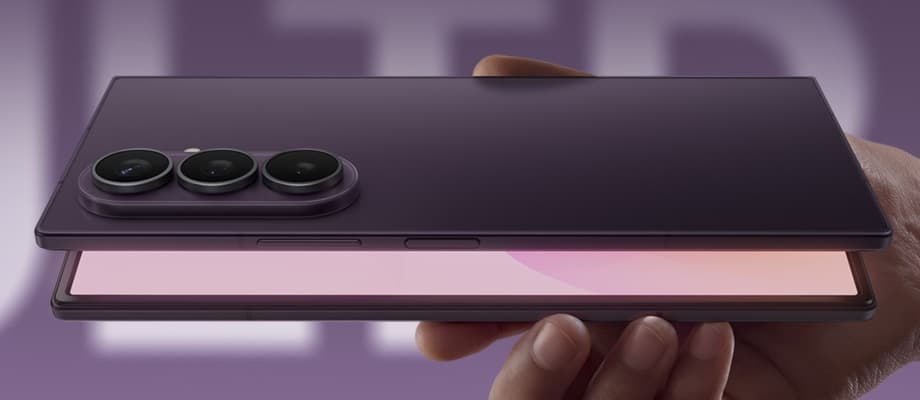
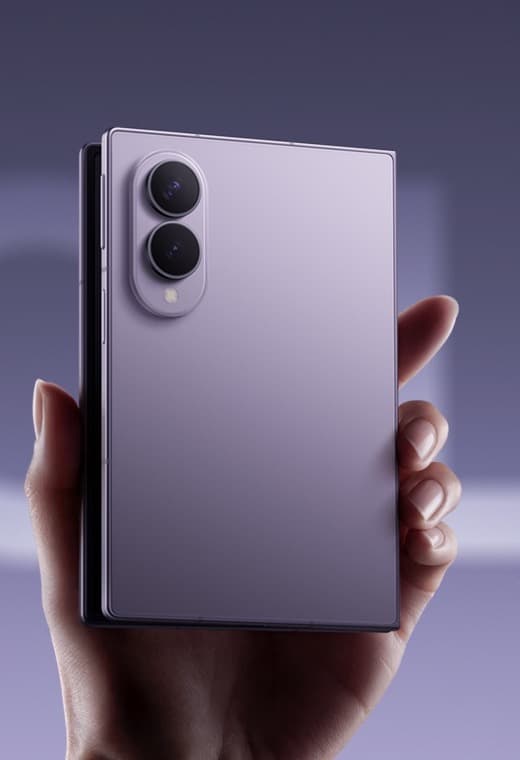
The Fold8 carries two rear lenses: a 50MP wide with optical stabilisation and a 2x optical-quality zoom taken from the sensor, plus a 50MP ultra-wide. The Ultra carries three: a 200MP wide, the same 50MP ultra-wide, and a 10MP telephoto with optical stabilisation at 3x optical zoom. The third lens is the architectural difference. One phone reaches 3x through dedicated glass and the other reaches 2x by cropping, which is a statement about the hardware and not a measurement of the pictures. Samsung publishes no comparable image testing for either model, and megapixel counts are not image quality, so what can be said is the count of focal lengths: two against three.
Battery capacity
5,000 mAh typical on the Ultra against 4,800 on the Fold8, both dual-cell, rated at 4,854 and 4,660 respectively. Samsung publishes no runtime figure for either phone, so there is nothing to compare on endurance and nothing to claim. Two hundred milliamp-hours of extra capacity sits in a larger body driving a larger screen, and how that nets out through a day is not something either maker has put a number on.
Charging
The charging hardware is the same on both: a 45W adapter with a 3A USB-C cable, 20W fast wireless charging, and Wireless PowerShare. Samsung's own thirty-minute figure on that adapter is 67% for the Ultra and 63% for the Fold8. Same manufacturer, same stated conditions, same stated duration, which makes these two numbers unusually comparable — four percentage points under one quoted test, rather than a general statement about either phone.
Size and weight
Folded, the Fold8 is 123.9 mm tall, 81.9 wide and 9.7 deep, at 201 g. The Ultra is 158.4 tall, 72.8 wide and 8.9 deep, at 215 g. Neither is simply the larger phone. The Ultra is 34.5 mm taller and 9.1 mm narrower, 0.8 mm thinner folded and 14 g heavier: one is short and wide, the other long, narrow and slimmer. Open, the Fold8 measures 161.4 mm across at 4.5 mm thick and the Ultra 143.2 mm at 4.1. Anyone who has held a Galaxy Z Fold7 has held the Ultra's closed body — the two are the same 158.4 by 72.8 by 8.9 mm at 215 g.
What is identical on both
The chip, down to the name: Snapdragon 8 Elite Gen 5 Mobile Platform for Galaxy. The software, Android 17 with One UI 9. The storage ladder, 256GB and 512GB with 12GB of memory and 1TB with 16GB. The water rating, IP48, tested for submersion in up to 1.5 metres of fresh water for up to thirty minutes, with Samsung advising against beach and pool use and noting the resistance is not permanent. The fold itself, inward along the long edge with a cover screen outside. And the update window, seven generations of OS upgrades and seven years of security updates from the initial global launch date. None of that is a reason to pick either one.
Which one may fit you better
Consider the Fold8 if $1,899.99 is the number that works, if you want the 201 g body or the much shorter 123.9 mm closed height, or if you unfold the phone mostly for video and side-by-side apps, which is the shape its landscape pane takes. Consider the Ultra if you want the 8.0-inch inner screen and the 6.5-inch cover, if a dedicated 3x telephoto is a lens you would use, or if a long narrow body sits in your pocket more comfortably than a short wide one.
Important considerations
These are closer to one phone in two shapes than to two tiers of one phone. Everything in the paragraph above on what is identical is genuinely shared, so the $200 buys glass, a lens and a body, and nothing underneath. Neither model has a published runtime figure, so battery life is unknown on both rather than settled in favour of the larger cell. And the folded dimensions are worth checking against your own pocket before anything else on this page, because 34.5 mm of height is the sort of difference a specification table flattens and a jeans pocket does not.