Apple iPhone Duo vs Samsung Galaxy Z Fold7
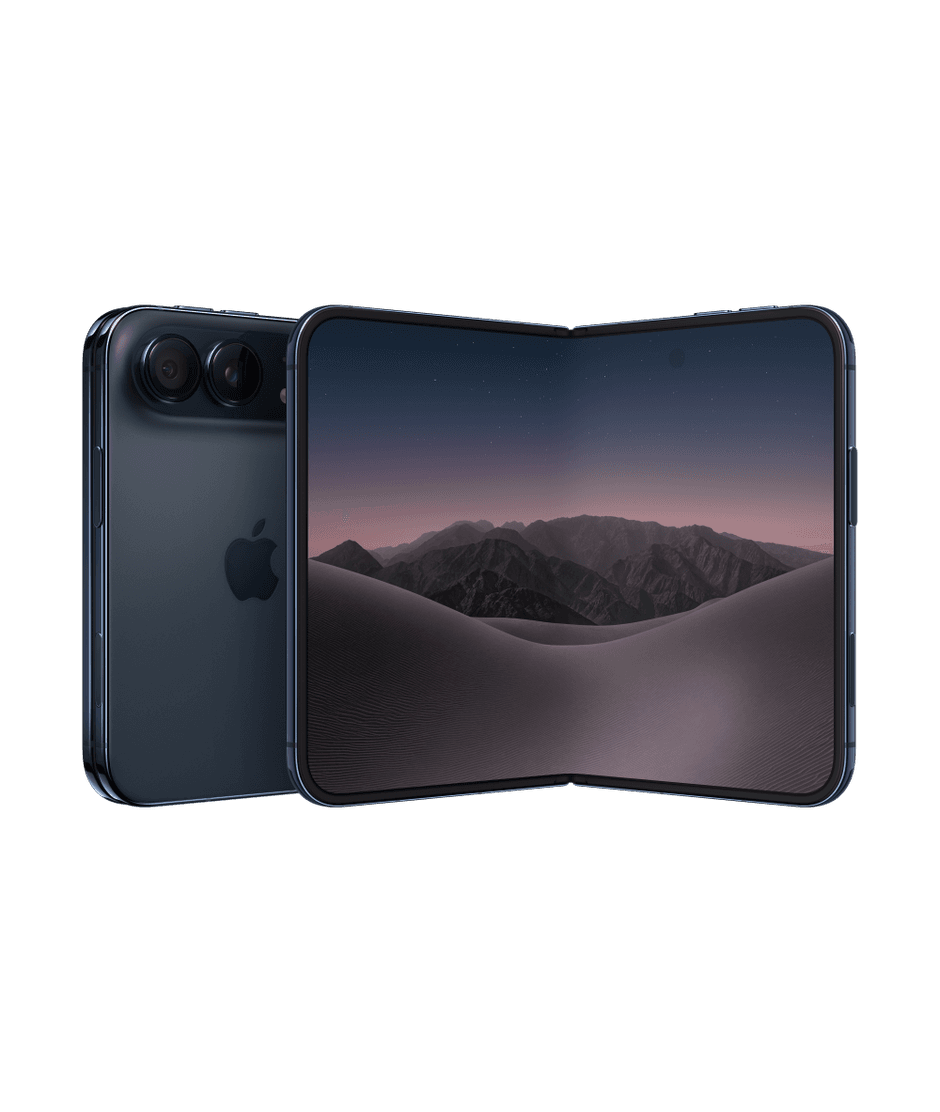
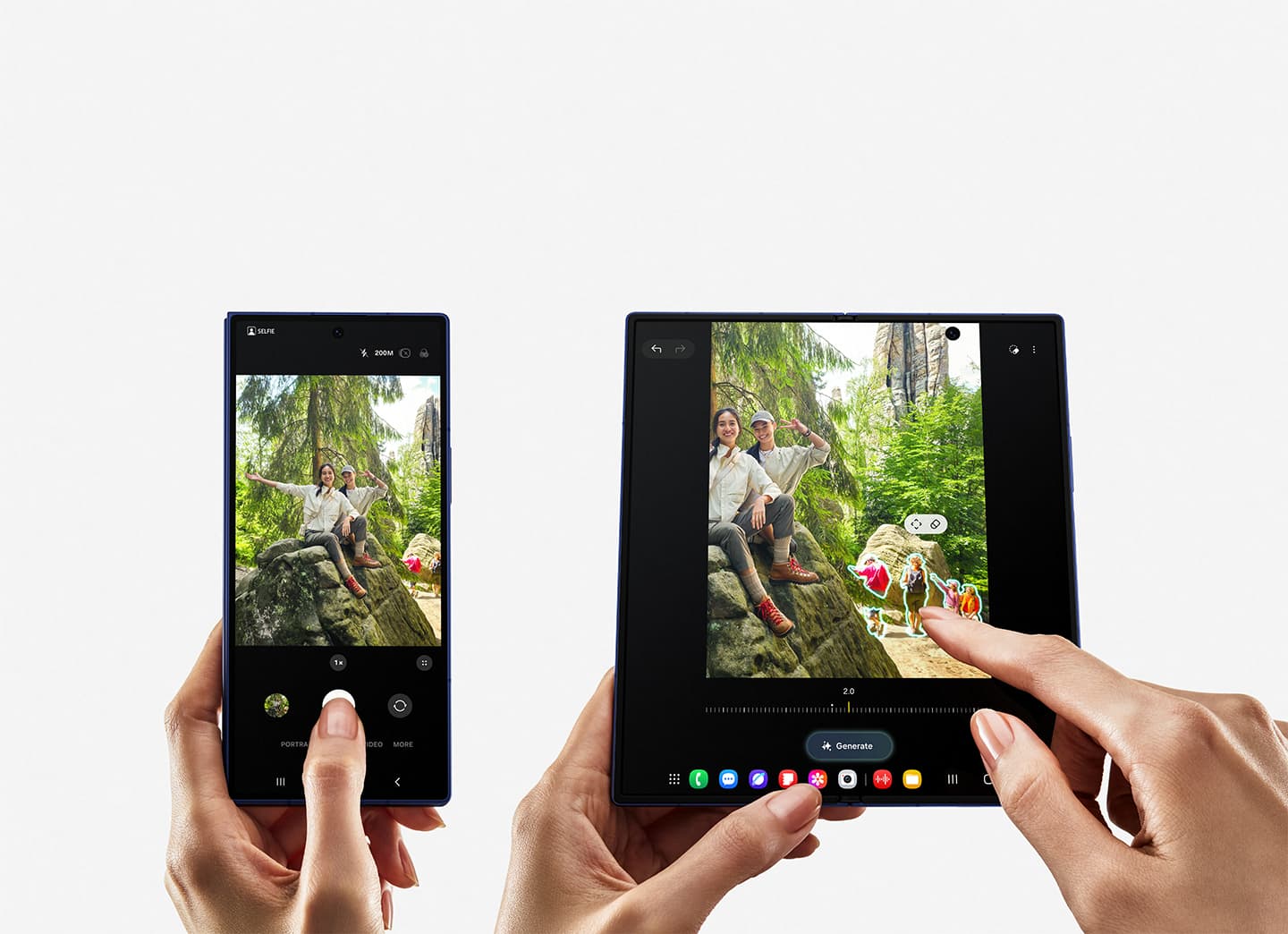
Within a dollar of each other at $1,999: iOS with two rear lenses and an IP68 rating, or Android with three lenses, 39 g less to carry, and IP48.
The short version
| Criterion | Apple iPhone Duo | Samsung Galaxy Z Fold7 |
|---|---|---|
| Operating system | iOS 27 | Android 16 with One UI 8 |
| Display | Inner 7.6-inch all-screen OLED Super Retina XDR folding display, 1878 x 2670 (tall x wide) at 430 ppi, nano-texture finish; Dynamic Island, Always-On, ProMotion up to 120Hz; 3000 nits peak outdoor | Inner 8.0-inch QXGA+ Dynamic AMOLED 2X, 2184 x 1968 (tall x wide) at 368 ppi, 120Hz adaptive refresh rate (1-120Hz) |
| Cover display | 5.4-inch all-screen OLED Super Retina XDR, 2034 x 1398 (tall x wide) at 460 ppi; Dynamic Island, Always-On, ProMotion up to 120Hz; 3000 nits peak outdoor | 6.5-inch FHD+ Dynamic AMOLED 2X, 2520 x 1080 (tall x wide), 21:9, at 422 ppi, 120Hz adaptive refresh rate (1-120Hz) |
| Camera system | 48MP Dual Fusion system: 48MP Fusion Main (26mm, f/1.6), which also enables a 12MP optical-quality 2x telephoto (52mm, f/1.6), and 48MP Fusion Ultra Wide (13mm, f/2.2, 120 degrees); 12MP Center Stage camera on the outer display (f/2.2); under-display FaceTime camera on the inner display (f/1.8) | 200MP wide (F1.7, OIS, 85 degree FOV), 12MP ultra-wide (F2.2, 120 degrees), 10MP telephoto (F2.4, OIS, 36 degrees, 3x optical zoom); 10MP cover camera (F2.2, 85 degrees); 10MP camera on the main screen (F2.2, 100 degrees) |
| Size and weight | Folded 117.8 mm tall x 84.1 wide x 11.3 deep; unfolded 117.8 tall x 164.6 wide x 5.2 deep; 254 g | Folded 158.4 mm tall x 72.8 wide x 8.9 deep; unfolded 158.4 tall x 143.2 wide x 4.2 deep; 215 g |
| Water resistance | IP68, to a maximum depth of 6 metres for up to 30 minutes, under IEC standard 60529 | IP48, based on lab conditions for submersion in up to 1.5 metres of fresh water for up to 30 minutes; Samsung does not advise beach or pool use |
| Storage | 256GB, 512GB, 1TB and 2TB | 256GB and 512GB with 12GB of memory; 1TB with 16GB of memory |
Which one fits
Consider Apple iPhone Duo if
- You are on iOS and want a phone that opens into a 7.6-inch screen
- You want an IP68 rating, documented to a maximum depth of 6 metres for up to 30 minutes
- You want 2TB of storage in a folding phone
Consider Samsung Galaxy Z Fold7 if
- You want a 200MP wide camera on a folding phone
- You want a folding phone that is 8.9 mm thick folded and weighs 215 g
- You want a narrower body when closed — 72.8 mm across folded
Main tradeoffs
- iOS 27, an IP68 rating documented to 6 metres, and a 2TB storage tier254 g, 11.3 mm folded and 84.1 mm across closed, with two rear lenses rather than three
- 215 g and 8.9 mm folded, an 8.0-inch inner screen and a 6.5-inch cover screen with a dedicated 3x telephotoAndroid with One UI rather than iOS, and IP48 with Samsung advising against beach and pool use
At a glance
| Criterion | Apple iPhone Duo | Samsung Galaxy Z Fold7 |
|---|---|---|
| Best for | People on iOS who want a phone that opens into a much larger screen and will pay $1,999 for it | People who want a phone that opens into a much larger screen, and will carry 215 g and a thicker folded body to get it |
| Pricing | From $1,999 | From $1,999.99; up to $2,499.99 at 1TB |
| Platform | iOS 27 | Android 16 with One UI 8 |
| Key differentiator | A folding iPhone running iOS 27, with a 7.6-inch inner display and Touch ID built into the side button rather than Face ID | A 6.5-inch cover screen that works closed and an 8.0-inch screen inside, 8.9 mm thick folded and 4.2 mm open |
| Category | Phones | Phones |
Key facts
| Fact | Apple iPhone Duo | Samsung Galaxy Z Fold7 |
|---|---|---|
| Price | From $1,999 | From $1,999.99 (256GB); $2,199.99 at 512GB; $2,499.99 at 1TB |
| Display | Inner 7.6-inch all-screen OLED Super Retina XDR folding display, 1878 x 2670 (tall x wide) at 430 ppi, nano-texture finish; Dynamic Island, Always-On, ProMotion up to 120Hz; 3000 nits peak outdoor | Inner 8.0-inch QXGA+ Dynamic AMOLED 2X, 2184 x 1968 (tall x wide) at 368 ppi, 120Hz adaptive refresh rate (1-120Hz) |
| Cover display | 5.4-inch all-screen OLED Super Retina XDR, 2034 x 1398 (tall x wide) at 460 ppi; Dynamic Island, Always-On, ProMotion up to 120Hz; 3000 nits peak outdoor | 6.5-inch FHD+ Dynamic AMOLED 2X, 2520 x 1080 (tall x wide), 21:9, at 422 ppi, 120Hz adaptive refresh rate (1-120Hz) |
| Size and weight | Folded 117.8 mm tall x 84.1 wide x 11.3 deep; unfolded 117.8 tall x 164.6 wide x 5.2 deep; 254 g | Folded 158.4 mm tall x 72.8 wide x 8.9 deep; unfolded 158.4 tall x 143.2 wide x 4.2 deep; 215 g |
| Fold type | Book-style foldable: folds inward along the long edge, with a cover screen on the outside | Book-style foldable: folds inward along the long edge, with a cover screen on the outside |
| Battery life | Typical use up to 24 hours; video playback up to 44 hours on the outer display and up to 31 hours on the inner; streamed video up to 37 hours outer and up to 26 hours inner | 4,400 mAh typical dual battery (rated 4,272 mAh); video playback up to 24 hours |
| Chip | A20 Pro chip, 6-core CPU, 7-core GPU with Neural Accelerators, dual 16-core Neural Engine | Snapdragon 8 Elite for Galaxy |
| Camera system | 48MP Dual Fusion system: 48MP Fusion Main (26mm, f/1.6), which also enables a 12MP optical-quality 2x telephoto (52mm, f/1.6), and 48MP Fusion Ultra Wide (13mm, f/2.2, 120 degrees); 12MP Center Stage camera on the outer display (f/2.2); under-display FaceTime camera on the inner display (f/1.8) | 200MP wide (F1.7, OIS, 85 degree FOV), 12MP ultra-wide (F2.2, 120 degrees), 10MP telephoto (F2.4, OIS, 36 degrees, 3x optical zoom); 10MP cover camera (F2.2, 85 degrees); 10MP camera on the main screen (F2.2, 100 degrees) |
| Operating system | iOS 27 | Android 16 with One UI 8 |
| Charging | Up to 50% in around 20 minutes with a 60W-capable adapter; MagSafe and Qi2 wireless up to 25W | Up to 50% in around 30 minutes with a 25W adapter and a 3A USB-C cable; Fast Wireless Charging 2.0; Wireless PowerShare |
| Storage | 256GB, 512GB, 1TB and 2TB | 256GB and 512GB with 12GB of memory; 1TB with 16GB of memory |
| Water resistance | IP68, to a maximum depth of 6 metres for up to 30 minutes, under IEC standard 60529 | IP48, based on lab conditions for submersion in up to 1.5 metres of fresh water for up to 30 minutes; Samsung does not advise beach or pool use |
Two book-style foldables that start within a dollar of each other at about $1,999, and almost nothing else lines up. One runs iOS and opens into a landscape screen; the other runs Android and opens into a portrait one. And only one is on sale today: the iPhone Duo takes pre-orders from 16 October 2026 and is available from 23 October.
Before anything else: availability
Only one of these two is on sale. Apple has announced the iPhone Duo, with pre-orders opening on 16 October 2026 and the phone available from 23 October 2026. The Galaxy Z Fold7 is on sale now. If you need a folding phone this week, that settles the page before any specification does.
Overview
These two start within a dollar of each other — $1,999 against $1,999.99 for the entry configuration — and almost nothing else lines up. They are both book-style foldables that fold inward along the long edge with a screen on the outside, and from there they disagree about which way the phone opens, how big the screen you use closed is, how many rear lenses it needs, how much water it survives, and which ecosystem you are committing to for the next several years.
Key differences
Four things decide it. The platform: iOS 27 against Android 16 with Samsung's One UI 8. The orientation: the Duo opens into a landscape screen and the Fold7 into a portrait one. The screen you use closed: 5.4 inches on the Duo against 6.5 inches on the Samsung, and those are different shapes as well as different sizes. And the published water and dust rating: IP68 against IP48, with Samsung's own advice not to take it to a beach or a pool.
The platform
This is the first question and for many people the only one. The Duo runs iOS 27 and the Z Fold7 runs Android 16 with One UI 8, Samsung's own layer on top. Neither is better and we do not say one is; what matters is the watch on your wrist, the laptop on your desk, the tablet in your bag and where your messages, photos and purchases already live. Moving between them is the real cost here, and it is not on any specification sheet. If you are already inside one of these two ecosystems, that is likely the end of the comparison.
The screen when it is open
Both open onto a much larger screen and they open the wrong way round from each other. The Duo's inner screen is 7.6 inches and measures 1878 by 2670 pixels, tall by wide — so it is wider than it is tall, and the body agrees: unfolded, the Duo is 117.8 mm tall and 164.6 mm wide. The Fold7's inner screen is 8.0 inches at 2184 by 1968, taller than it is wide, in a body that unfolds to 158.4 mm tall by 143.2 wide. A landscape panel suits video and two apps beside each other; a portrait one suits reading, scrolling and a single app at full height. That is a bigger practical difference than the four tenths of an inch between them. Both run to 120Hz, and the pixel densities are 430 and 368 ppi.
The cover screen
Closed, these two are not the same kind of object. The Duo's outer display is 5.4 inches, 2034 by 1398 at 460 ppi, in a body that is 117.8 mm tall and 84.1 wide — short and broad, which is what a landscape-opening design leaves you holding. The Fold7's cover screen is 6.5 inches, 2520 by 1080 at 422 ppi and 21:9, in a body 158.4 mm tall and 72.8 wide, which is close to the proportions of an ordinary phone. If you expect to spend most of the day with the phone shut, the Samsung is the one that behaves like a normal phone while it is; the Duo asks you to open it more often.
Cameras
Two designs rather than a better and a worse one, and the lens count is the clearest way to describe the difference without pretending to rank it. The Duo has two rear lenses: a 48MP Fusion Main at 26mm f/1.6, which also produces a 12MP optical-quality 2x telephoto at 52mm by cropping the main sensor, and a 48MP Fusion Ultra Wide at 13mm f/2.2. The Fold7 has three: a 200MP wide at F1.7 with OIS, a 12MP ultra-wide, and a 10MP telephoto with OIS at 3x optical. So the Samsung has a dedicated telephoto lens and reaches further optically; the Apple reaches less far but does it from a sensor it already has. Megapixels are not a measure of quality and we do not read them as one: 200MP and 48MP describe two different approaches to the same picture. Both put a camera on the outside and another for the inner screen; on the Duo the inner one is under the display.
Folded size and weight
Folded, the Duo is 117.8 mm tall, 84.1 wide and 11.3 deep, at 254 g. The Fold7 is 158.4 tall, 72.8 wide and 8.9 deep, at 215 g. So the Samsung is lighter by 39 g and thinner by 2.4 mm folded, and narrower by 11.3 mm, while being 40.6 mm taller. Unfolded the thicknesses are 5.2 mm and 4.2 mm. Which of those shapes fits your pocket is worth answering with the actual numbers rather than from a photograph: one of these is a tall narrow bar and the other is a short wide block.
Water and dust
A real difference, and worth stating as the two classifications rather than as a single word. The iPhone Duo is rated IP68, which Apple documents to a maximum depth of 6 metres for up to 30 minutes under IEC standard 60529. Samsung rates the Galaxy Z Fold7 IP48, documenting submersion to 1.5 metres of fresh water for up to 30 minutes in lab conditions, and advising against beach and pool use. The leading digit of each is the solid-particle one: a 4 stops objects larger than 1 mm, where a 6 means dust-tight. So the gap is about dust as much as about water, and Samsung's own advisory is the plainest statement of where the Fold7 should not go.
Storage
The Duo is sold in 256GB, 512GB, 1TB and 2TB. The Fold7 is sold in 256GB, 512GB and 1TB, and Samsung also publishes the memory attached to each tier: 12GB at 256GB and 512GB, and 16GB at 1TB. So the Duo's ceiling is one tier higher, and Samsung tells you something about its configurations that Apple does not publish for this phone. Whether a 2TB ceiling is worth anything depends entirely on whether you would ever fill 1TB.
Battery
We are not putting these two side by side, because there is no test they have both run. Apple publishes five figures for the Duo: typical use up to 24 hours, video playback up to 44 hours on the outer display and up to 31 on the inner, and streamed video up to 37 hours outer and up to 26 inner. Samsung publishes two for the Fold7: a typical capacity of 4,400 mAh and video playback of up to 24 hours. Both print the number 24 for different things, and Apple's 44 hours is one screen alone. Each product's own page carries its maker's figures in full, and that is the only honest place for them.
Charging
Apple quotes up to 50% in around 20 minutes with a 60W-capable adapter, plus MagSafe and Qi2 wireless up to 25W. Samsung quotes up to 50% in around 30 minutes with a 25W adapter and a 3A USB-C cable, plus Fast Wireless Charging 2.0 and Wireless PowerShare for topping up accessories from the phone. Those are two claims made with different adapters at different wattages, so treat them as two claims rather than a measured result. The Samsung is the only one of the two that can charge something else from its own battery.
Updates
Neither maker publishes a minimum update period for these two phones in the sources we use, so our software support field is empty on both. We will not turn two silences into a shared commitment, and we will not guess a number for either. If a published commitment is part of what you are buying, neither of these two gives you one to read.
Unlocking
One note that only goes one way. Apple documents Touch ID in the side button for the Duo rather than Face ID, which is worth knowing if you are coming from another iPhone. We hold no equivalent documented statement about how the Z Fold7 unlocks, so there is no comparison to draw here — only the Apple fact, on its own.
Which one may fit you better
Consider the iPhone Duo if you are already on iOS, if an IP68 rating matters to you, if you want a 2TB tier, or if a landscape screen when open is the shape you would actually use. Consider the Galaxy Z Fold7 if you are on Android or willing to be, if you want the lighter and thinner body folded, if you want a phone that behaves like an ordinary phone while it is closed, if you want a dedicated 3x telephoto lens, or if you want to buy a folding phone today.
Important considerations
The availability gap is the first filter and the IP48 rating is the second: those two can rule a phone out rather than place it, and everything else on this page is a preference. Beyond that, the platform choice is the one you cannot undo cheaply, because it reaches your watch, your tablet and every subscription attached to the account. And 39 g and 2.4 mm folded is a difference you carry every day. Neither link on this page is a paid placement: both go to the maker's own store.