WHOOP vs Garmin Venu 4
One is a screen-free band sold as a yearly membership from $199 and built around recovery; the other is an AMOLED smartwatch bought once from $549.99, with GPS, payments and 10 to 12 days of battery. They overlap on continuous health and sleep tracking, and diverge on nearly everything else — starting with whether you read your data on your wrist or only in an app.
Affiliate disclosure: we may earn a commission from eligible partner links. Read our affiliate disclosure
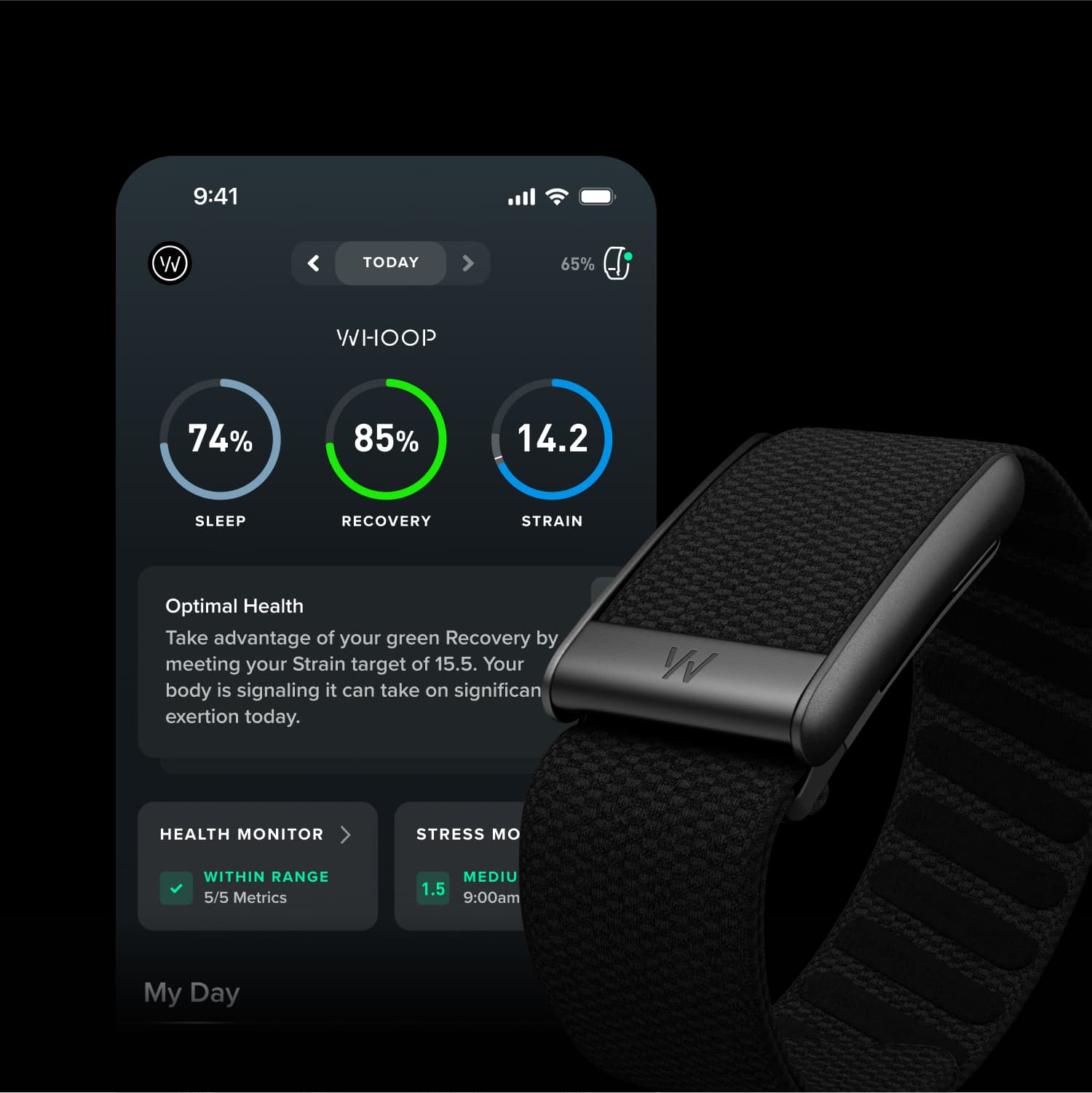
WHOOP
A screen-free fitness and health wearable focused on recovery, strain, sleep and long-term performance insights through a subscription-based membership.
Best forContinuous recovery, sleep and strain tracking
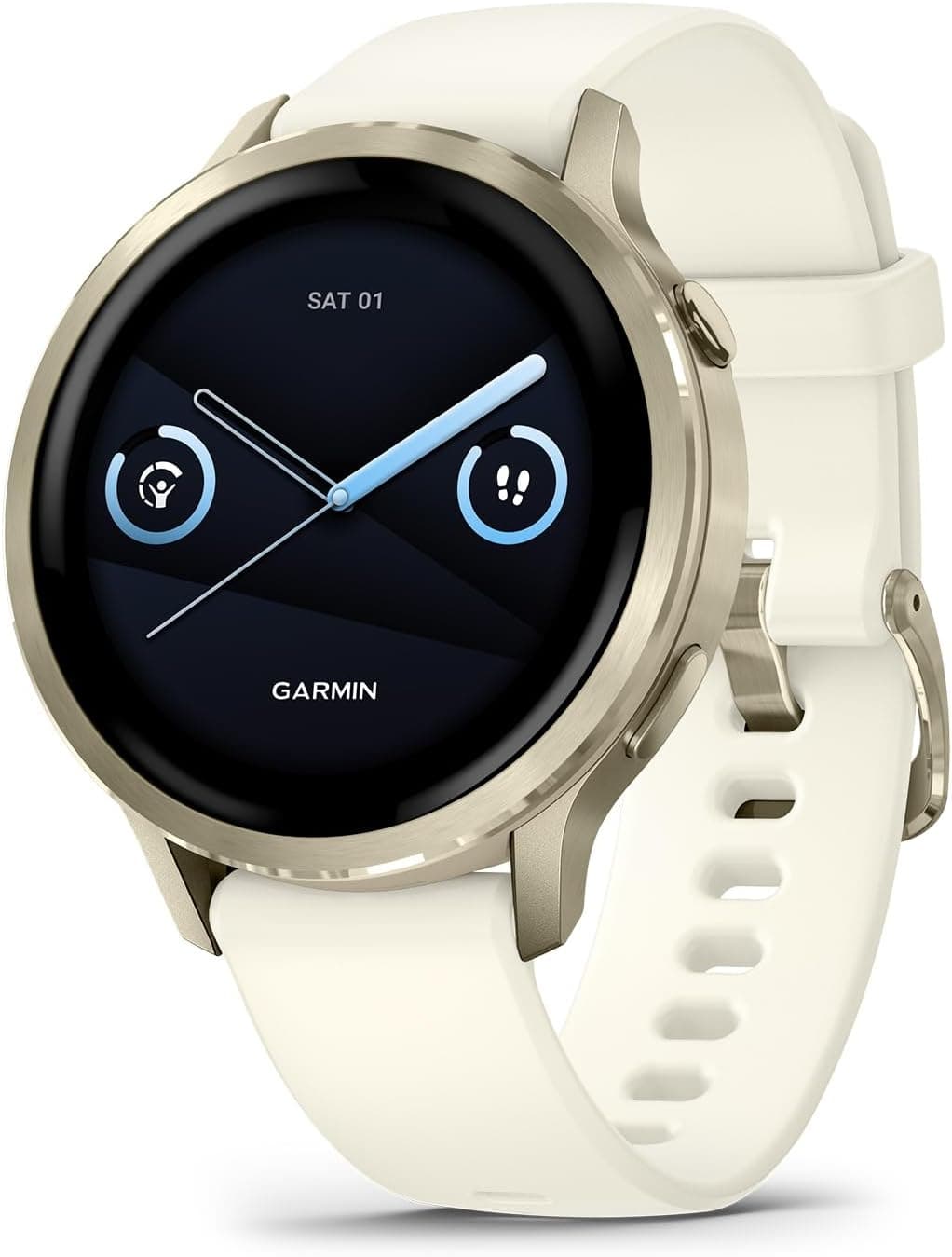
Garmin Venu 4
A fitness and wellness smartwatch from $549.99 with an AMOLED display, multi-band GPS and up to 12 days of battery, working with both iPhone and Android.
Best forMulti-day battery with full training and recovery tracking
Quick answer
Choose WHOOP if
- You want recovery, sleep and strain scores every day rather than a watch face
- You would rather not have a screen or notifications on your wrist
- You train regularly and will act on daily recovery guidance
- You want longer-term health context such as Healthspan and heart-health features
- A yearly membership that includes the hardware suits you better than buying a device outright
Choose Garmin Venu 4 if
- You want smartwatch features and detailed fitness metrics in one device
- You would rather charge weekly than nightly
- You want training readiness, Body Battery and recovery tools without a subscription
- You use either an iPhone or an Android phone and want the same experience
- You want GPS, offline music and contactless payments on the wrist
At a glance
| Criterion | WHOOP | Garmin Venu 4 |
|---|---|---|
| Best for | Continuous recovery, sleep and strain tracking | Multi-day battery with full training and recovery tracking |
| Pricing | Yearly membership from $199/yr; device included | One-off purchase from $549.99; no subscription |
| Trial | 1-month free trial of Peak with a certified pre-owned WHOOP 5.0 | No trial — the watch is bought outright |
| Platform | Wearable + iOS and Android app | Garmin Connect on iPhone and Android |
| Key differentiator | Screen-free band sold as a membership, focused on recovery and long-term health metrics | Up to 12 days of battery with full Garmin training and recovery metrics |
| Category | Wearables | Wearables |
Key facts
| Fact | WHOOP | Garmin Venu 4 |
|---|---|---|
| Price | Membership from $199/yr | Starting at $549.99 |
| Battery life | 14+ days | 41mm: up to 10 days; 45mm: up to 12 days |
| Display | None — screen-free band | AMOLED touchscreen, optional always-on |
| Water resistance | IP68, up to 10 m | 5 ATM |
| Platform | iOS and Android app | iPhone and Android via Garmin Connect |
| Subscription | — | None required |
| Core focus | — | Fitness and wellness smartwatch with training tools |
| Case sizes | — | 41 mm and 45 mm |
Overview WHOOP and Garmin Venu 4 both sit on your wrist and both track your body around the clock, but they are different categories of device. WHOOP has no screen at all: it is a band sold through a yearly membership that bundles the hardware, and everything you see arrives through the app. Venu 4 is a full smartwatch with an AMOLED touchscreen, bought once, carrying GPS, contactless payments, music and a flashlight on the device itself. They overlap on continuous heart-rate and sleep tracking and on daily guidance about how hard to train. They diverge on nearly everything about how you use them day to day. Price and membership These are two commercial models rather than two price tags, so the gap is not a simple one. WHOOP has no separate hardware price: membership starts at $199/yr for WHOOP One and includes the device, with Peak at $239/yr and Life at $359/yr, the last shipping the WHOOP MG instead of the WHOOP 5.0. Stop paying and the service stops. There is a one-month free trial of Peak with a certified pre-owned WHOOP 5.0. Venu 4 is a single purchase from $549.99 with no trial, at the same list price across both case sizes, and the core Garmin Connect experience — training readiness, Body Battery, sleep coaching and the coaching plans — carries no required subscription. Over one year Venu 4 costs more up front; over several years the membership keeps accruing while the watch does not. Which model fits depends on whether you would rather own hardware outright or pay for a service that keeps the hardware current. Design and interaction This is the central difference between them. WHOOP is screen-free by design: there is nothing to read on the band, no watch face and no notifications, and every number is reviewed in the app. Venu 4 has a 1.2-inch, 390 x 390 AMOLED touchscreen on the 41 mm model with an optional always-on mode, so the same data is available at a glance on the wrist and in Garmin Connect afterwards. The consequence is about attention rather than capability: WHOOP removes the wrist as a place to look, which some people choose deliberately, while Venu 4 makes the wrist the primary interface. Physically, Venu 4 comes in 41 mm and 45 mm with a stainless steel bezel, Corning Gorilla Glass 3 and 18 mm quick-release bands, and the 41 mm weighs 33 g without its band. On water, WHOOP is rated IP68 and stated as water resistant to 10 meters, and Venu 4 at 5 ATM, which Garmin describes as withstanding pressure equivalent to 50 metres depth. Both ratings cover showering and swimming. Sleep tracking Both treat sleep as a core function and both are meant to be worn overnight. WHOOP scores sleep on quality rather than duration alone and feeds it directly into the next day's Recovery figure, which is the number the whole system is organised around. Venu 4 offers advanced sleep tracking with Sleep Coach, sleep alignment and nap detection, feeding its own readiness and Body Battery readings. The practical difference is charging: WHOOP charges through a Wireless PowerPack that slides onto the band, so the device never comes off the wrist, while Venu 4 has to be removed — though at 10 to 12 days between charges that is an infrequent interruption. Recovery and readiness Both platforms produce a daily read on whether to push or hold back, under different names and with different supporting metrics. WHOOP reports Recovery, Strain and Sleep, with Strain measured across the whole day and more than 145 supported activities, and the daily Recovery figure is what the system expects you to plan around. Venu 4 reports Training Readiness, Training Status and Recovery Time, alongside Body Battery energy monitoring and HRV status. Neither company publishes a head-to-head accuracy comparison against the other, so the choice here is about which presentation you will actually act on, not about which reading is more correct. Training and workouts WHOOP's guidance is organised around daily strain targets and recovery, with activities logged across a broad list and the coaching layer included in the membership. Venu 4 carries a fuller workout toolkit on the device itself: Garmin Fitness Coach builds adaptive plans across more than 25 activities, adjusting daily against activity history, sleep and recovery, alongside running, cycling and strength coaching plans, daily suggested workouts, and strength, HIIT, yoga, pilates and cardio sessions with on-screen animations and muscle maps. It also includes a wheelchair mode and workouts built for wheelchair users. Because Venu 4 has a display, a workout can be followed on the wrist; with WHOOP the phone does that job. Health metrics WHOOP covers continuous heart rate, strain, recovery and sleep on every tier, and reserves its deeper health features for the upper ones: Healthspan with WHOOP Age on Peak and above, and Blood Pressure Insights, the Heart Screener with ECG and on-demand AFib detection only on Life at $359/yr. Venu 4 includes wrist heart rate, Pulse Ox, respiration rate, all-day stress, HRV status, skin temperature, Fitness Age and an ECG app without tier gating, plus lifestyle logging — recording things like caffeine or alcohol and seeing how they track against sleep, stress and HRV — and a Health Status feature that flags when metrics drift from your usual range. Garmin lists Health Status as being in beta. Both companies state these are wellness and performance features rather than diagnostic tools, and both restrict them by age and region. For Garmin specifically: the ECG App records an ECG similar to a Lead I ECG and can detect atrial fibrillation or normal sinus rhythm, with availability regulated and varying by market; Pulse Ox is not a medical device, is not intended for diagnosing or monitoring any condition, and is not available in all countries; and menstrual cycle tracking should not be used for conception, contraception or birth control. Confirm what is active in your market before choosing on the strength of one feature. Battery life WHOOP states 14+ days per charge, and its Wireless PowerPack slides onto the band so charging happens while you wear it. Garmin's own figures for Venu 4 are up to 10 days in smartwatch mode on the 41 mm and up to 12 on the 45 mm, extending to 18 and 25 days in battery saver mode. With GPS running, expect up to 15 hours on the 41 mm and 20 on the 45 mm in GPS-only mode, dropping to around 6 and 9 hours with all satellite systems and music together, and leaving the display always-on costs roughly two thirds of the smartwatch figure. Both are multi-day devices, which is uncommon in this category. The difference is in method: WHOOP's charging never takes the device off your wrist, while Venu 4 runs longer in battery saver mode. GPS and outdoor tracking Here the two are genuinely asymmetric. WHOOP has no built-in GPS. WHOOP's own support documentation states that the strap is not equipped with GPS and that route tracking relies on your mobile device, through Strain Coach with Track Route enabled and the phone carried for the duration of the activity. Venu 4 has GPS on the watch, covering GPS, GLONASS, Galileo, QZSS and BeiDou with multi-band reception plus Garmin's SatIQ mode, which trades accuracy against battery automatically, so runs and rides need no phone. If recording a route without carrying a phone matters to you, that requirement points to Venu 4. If you carry a phone on every session anyway, the difference narrows to convenience. Smartwatch features This is a difference of category rather than a shortfall on either side. Venu 4 carries the smartwatch set: onboard music storage, Garmin Pay, smart notifications, Connect IQ apps and watch faces, weather, calendar, morning and evening reports, a built-in speaker and microphone that let you take calls through a paired phone and reach its voice assistant, some voice commands that work on the watch alone, an LED flashlight, 8 GB of memory, and Bluetooth, ANT+ and Wi-Fi. On Venu 4, replying to texts and viewing images from notifications are Android-only. WHOOP has none of these, and that is the design rather than an omission: it is a sensor and a membership, not a wrist computer, and people who choose it often do so precisely to keep notifications off their arm. If you want music, payments or calls from your wrist, WHOOP is not built for that and Venu 4 is. Apps and ecosystem WHOOP runs its own app on iOS and Android and is self-contained: the membership is the ecosystem, and the coaching, trends and health features all live inside it. Venu 4 syncs to Garmin Connect, where longer-term trends, lifestyle logging reports and coaching plans live, and it pairs with Garmin's wider accessory range including heart rate straps and smart scales. Garmin does not gate these features behind a subscription, which is the structural difference from a product sold as a membership. Phone compatibility Both work with iPhone and Android. WHOOP runs its app on both platforms, and Venu 4 connects through Garmin Connect on both. Neither locks you to a phone platform, so unlike some comparisons in this category, the phone in your pocket does not settle this one. The nuance is that WHOOP depends on the phone more often in practice, because the phone is both the display and, for route tracking, the GPS. Which may suit you WHOOP may suit someone who wants recovery, sleep and strain scores every day rather than a watch face, who would rather not have a screen or notifications on the wrist, who trains regularly and will act on daily guidance, and for whom a yearly membership that includes the hardware is a reasonable trade. Venu 4 may suit someone who wants a smartwatch with a display, GPS and workouts on the wrist, and smartwatch functions such as payments, music and calls, who would rather buy the device once with no required subscription for the core experience, and who wants training readiness and recovery tooling without a recurring fee. Anyone who wants both a screen on the wrist and a membership-led coaching model is served by neither, since each has deliberately taken the opposite position on one of those axes. Bottom line These products answer partly overlapping questions through very different experiences. WHOOP removes the screen and sells an ongoing service organised around recovery; Venu 4 puts a full smartwatch on the wrist with onboard GPS and multi-day battery and asks for no subscription for its core features. The decision usually resolves before any feature list: whether you want to read your data on your wrist or only in an app, and whether you would rather own the hardware or pay for the service built around it. Prices, tiers and regional availability change; confirm current terms with WHOOP and Garmin before buying.