WHOOP vs Oura Ring 5
Both are screenless, worn around the clock and read entirely in an app, and both run for days between charges. The split is where you wear it and how you pay: WHOOP is a wrist band built around strain and training, sold as a membership from $199/yr that includes the hardware, while Oura Ring 5 is a titanium ring built around sleep and readiness, bought outright from $399 with an optional membership at $5.99/mo.
Affiliate disclosure: we may earn a commission from eligible partner links. Read our affiliate disclosure
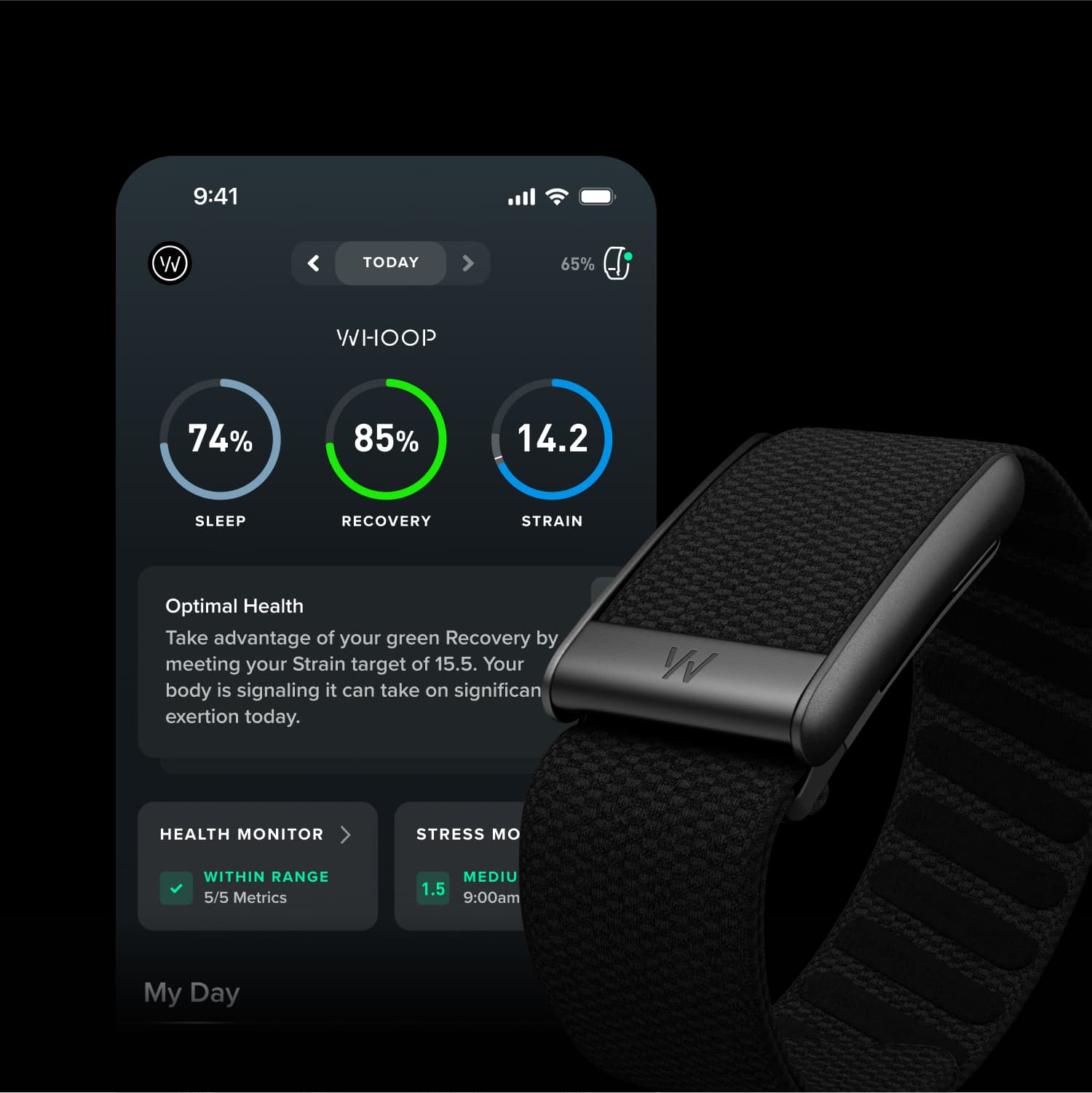
WHOOP
A screen-free fitness and health wearable focused on recovery, strain, sleep and long-term performance insights through a subscription-based membership.
Best forContinuous recovery, sleep and strain tracking
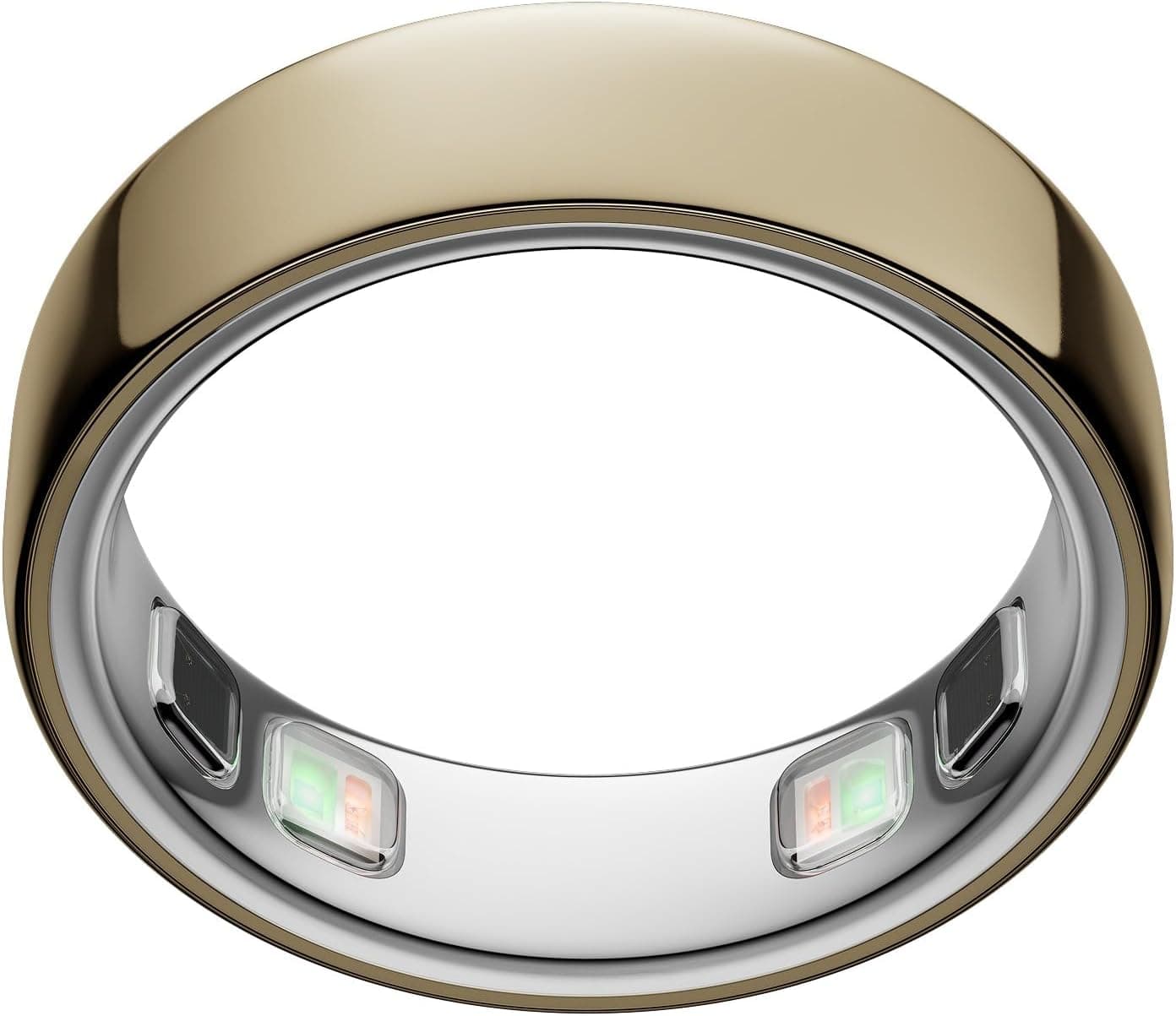
Oura Ring 5
A screenless titanium smart ring from $399 that tracks sleep, readiness and recovery around the clock, with an Oura Membership for the full app experience.
Best forDetailed sleep, readiness and recovery tracking in a ring
Quick answer
Choose WHOOP if
- You want recovery, sleep and strain scores every day rather than a watch face
- You would rather not have a screen or notifications on your wrist
- You train regularly and will act on daily recovery guidance
- You want longer-term health context such as Healthspan and heart-health features
- A yearly membership that includes the hardware suits you better than buying a device outright
Choose Oura Ring 5 if
- You want detailed sleep tracking from something you can forget you are wearing
- You would rather wear a ring than a watch or a wrist band
- You want daily readiness and recovery guidance rather than workout controls
- You want passive health tracking with no screen and no notifications
- Six to nine days between charges suits you better than nightly charging
At a glance
| Criterion | WHOOP | Oura Ring 5 |
|---|---|---|
| Best for | Continuous recovery, sleep and strain tracking | Detailed sleep, readiness and recovery tracking in a ring |
| Pricing | Yearly membership from $199/yr; device included | From $399 one-off; membership $5.99/mo or $69.99/yr |
| Trial | 1-month free trial of Peak with a certified pre-owned WHOOP 5.0 | One month of Oura Membership included from pairing |
| Platform | Wearable + iOS and Android app | Oura App on iOS 16+ and Android 11+ |
| Key differentiator | Screen-free band sold as a membership, focused on recovery and long-term health metrics | A 2-gram titanium ring with 6-9 day battery, read entirely through the app |
| Category | Wearables | Wearables |
Key facts
| Fact | WHOOP | Oura Ring 5 |
|---|---|---|
| Price | Membership from $199/yr | From $399 (Silver, Black); other finishes $499 |
| Battery life | 14+ days | Typically 6-9 days |
| Display | None — screen-free band | Screenless — data read in the Oura App |
| Water resistance | IP68, up to 10 m | 100 m, IP68 |
| Platform | iOS and Android app | iOS 16+ and Android 11+ |
| Subscription | — | Membership $5.99/mo or $69.99/yr |
| Trial | — | One month included from pairing |
| Core focus | — | Sleep, readiness and recovery tracking |
Overview WHOOP and Oura Ring 5 have more in common than most pairs in this category. Neither has a screen, both are worn continuously including overnight, both run for days between charges, both produce a daily read on how recovered you are, and both put all of it in a phone app. The differences are where you wear it, what the system is organised around, and how you pay. WHOOP is a band on your wrist, built around strain and training, sold as a membership that includes the hardware. Oura Ring 5 is a titanium ring, built around sleep, readiness and long-term health trends, bought outright with a membership that is optional but does most of the work. Price and membership The two use genuinely different commercial models, so the headline numbers are not comparable on their own. WHOOP has no separate hardware price: membership starts at $199/yr for WHOOP One and includes the device, with Peak at $239/yr and Life at $359/yr, the last shipping the WHOOP MG instead of the WHOOP 5.0. Stop paying and the service stops. The trial is a one-month free trial of Peak with a certified pre-owned WHOOP 5.0. Oura separates the two. The ring is bought outright at $399 in Silver and Black, or $499 in Gold, Deep Rose, Stealth and Brushed Silver, and Oura Membership is $5.99 per month or $69.99 per year, with one month included from the moment the ring is paired. Membership is optional rather than required, and Oura documents what remains without it: your three daily scores, Readiness, Activity and Sleep, plus ring battery, basic profile information, app settings and the Explore content. The detailed analysis, personalised insights and the API sit behind the membership. So a lapsed Oura member keeps a working ring producing its headline numbers, while a lapsed WHOOP member has a device that stops. Band vs ring This is the most practical difference between them. WHOOP is worn on the wrist, or on the upper arm with its apparel range. Oura is a ring: titanium inside and out with a superhard PVD coating, 6.09 mm wide, 2.28 mm thick, from 2 grams depending on size, in whole sizes 6 to 13. A ring is more discreet than a band and leaves the wrist free for a watch, which is part of why people choose one. It is also the less adjustable of the two: a strap can be loosened, a ring cannot be resized after purchase, which is why Oura sells a sizing kit and why getting the size right before buying matters more here than on any wrist device. On water, WHOOP is rated IP68 and water resistant to 10 meters; Oura is rated 100 m and IP68, which Oura describes as suitable for sauna and water sports but not diving. Both cover showering and swimming. Neither company publishes a comparative comfort study, so which is more pleasant to wear all day and all night is a personal matter rather than a specification. Screenless experience Both are screenless, and in both cases the data is read in the app rather than on your body. WHOOP has no display and no notifications; Oura has nothing to read on your hand. Neither treats this as a compromise, and buyers of both often choose the form precisely to keep information off their person until they go looking for it. The practical consequence is the same on both sides: your phone is the interface, so the quality of the app matters more than it would on a watch, and neither device will tell you the time, show a message or display live workout figures. Sleep tracking Sleep is central to both. WHOOP scores sleep on quality rather than duration alone and feeds that directly into the next day's Recovery figure. Oura reports a Sleep Score built from total sleep, heart rate variability, nighttime movement, sleep regularity and more, with sleep stages covering deep, REM and light, plus Bedtime Guidance, Nighttime Breathing, and blood oxygen sensing that can indicate breathing disturbances during the night. Both are light enough to wear overnight. Neither company publishes a head-to-head accuracy comparison against the other, so the choice is about which presentation and which set of nightly outputs you will act on. Recovery and readiness Both produce a daily figure meant to guide how hard you push, but they are built differently and are not interchangeable readings. WHOOP reports Recovery, Strain and Sleep, with Strain measured across the whole day and more than 145 supported activities, and the daily Recovery figure is what the system expects you to plan around. Oura reports a Readiness Score drawn from temperature trends, heart rate, sleep and other inputs, alongside an Activity Score covering activity levels, consistency and recovery time. The inputs overlap — heart rate, HRV, sleep — but the scores are each company's own construction, calculated their own way and scaled their own way, so a number from one does not translate to the other. Stress and resilience Oura publishes two separately named features here: Daytime Stress, which shows how movement, activities and tags contribute to stress through the day, and Resilience, which tracks how well the body recovers from day-to-day physiological stress over a longer horizon. Our verified record for WHOOP covers Recovery, Strain and Sleep and does not document a separately named daytime stress or resilience score, so there is no counterpart to line up against these. That is a difference in how each company packages its metrics rather than evidence that one measures something the other cannot. Health metrics WHOOP covers continuous heart rate, HRV, respiratory rate, strain, recovery and sleep on every tier, and gates its deeper health features by tier: Healthspan with WHOOP Age on Peak and above, and Blood Pressure Insights, the Heart Screener with ECG and on-demand AFib detection only on Life at $359/yr. Oura's sensor set is two tri-LED emitters covering red, green and infrared light, two photodetectors, a digital temperature sensor and an accelerometer, producing 24/7 heart rate, HRV, respiration rate, blood oxygen sensing and temperature trends, plus Cardiovascular Age, Cardio Capacity as a VO2 Max estimate, Blood Pressure Signals and cycle insights, none of them tier-gated. Oura groups several of these under Health Radar, which includes Symptom Radar, a feature watching biometrics such as body temperature, respiratory rate, resting heart rate, HRV and inactive time that can flag signs of strain sometimes before symptoms of a cold or flu are felt. Both companies are explicit that these are wellness and performance features, not diagnostic tools. Oura states that Health Radar features are intended for general wellness purposes only and are not intended to diagnose, treat, cure, mitigate, monitor or prevent any disease, illness or medical condition, and do not provide medical advice; that they should not replace clinical assessment or be used to delay, stop or modify medical care; and that anyone with health concerns should consult a doctor or other qualified healthcare professional. WHOOP likewise restricts its health features by age and region, and its regulated features sit on its top tier. A flag, a trend or a signal from either device is a prompt to pay attention, not a finding. Activity and workouts WHOOP is the more training-oriented of the two. Strain is measured across the whole day across more than 145 supported activities, and the coaching layer that interprets it is included in every membership. Oura automatically detects more than 40 activities with heart rate, and workouts can also be logged by hand or imported from third-party apps. Neither has on-device workout controls, because neither has a screen, so in both cases starting, following or reviewing a session happens on the phone. If structured daily training guidance is the reason for buying, WHOOP is organised around that; if workouts are something you want recorded rather than directed, Oura covers it. Battery life WHOOP states 14+ days per charge, and its Wireless PowerPack slides onto the band so the device never has to come off your wrist. Oura is quoted at typically six to nine days, varying with ring size and usage, charging in about 80 minutes over USB-C, with a separate charging case sold that Oura says returns a full day of battery in ten minutes. Both are multi-day devices by design. WHOOP runs roughly twice as long and can be charged while worn; Oura has to come off, though a ten-minute top-up covers a day if you are about to sleep on it. GPS Neither device has GPS of its own, and both depend on your phone, but the implementations are documented differently. WHOOP states the strap is not equipped with GPS and that route tracking runs through Strain Coach with Track Route enabled, with the phone carried for the duration of the activity. Oura states the ring has no built-in GPS and that the Oura App uses the phone's GPS to show live pace, distance and a real-time map for supported outdoor activities, requiring the phone on you and the app running in the background before the activity starts; Oura also notes the ring does not stream live heart rate to the phone screen during an activity. The conclusion is the same for both — leave your phone behind and you lose the route — but the setup each asks for is not identical. Apps and ecosystem WHOOP runs its own app on iOS and Android and is largely self-contained: the membership is the ecosystem. Oura's app requires iOS 16 or higher or Android 11 or higher, with Bluetooth 5.0 on the phone, and documents an Apple Health integration on iOS and a Health Connect integration on Android, both of which require an active membership; Oura imports workouts, weight and height and exports resting heart rate. Linking those apps also imports height, weight, age and sex into Oura, which then cannot be edited unless the apps are unlinked. Both work with either phone platform, so the phone in your pocket does not decide this comparison. Which may suit you WHOOP may suit someone who trains regularly and wants strain and recovery guidance to plan around, who is comfortable wearing a band on the wrist or upper arm, and for whom a yearly membership that bundles the hardware is a reasonable way to pay. Oura Ring 5 may suit someone who wants a device that disappears on the hand, whose priority is sleep, readiness, stress and longer-term health trends rather than training direction, who would rather own the hardware and treat the membership as a separate decision, and who is willing to size carefully before buying. Bottom line These are two takes on the same idea, built for different days. Three questions usually settle it before any feature list. Do you want training and strain guidance, or health and sleep trends? Do you want it on your wrist or on your finger? And would you rather rent the whole product as a membership, or buy the hardware and decide about the software separately? Prices, tiers, membership terms and regional availability all change; confirm current terms with WHOOP and Oura before buying.