3 options covered
Best Foldable Phones
Three of the ten phones we track fold open into a second, much larger screen. They are the whole field rather than a shortlist, and they disagree about nearly everything else: the shape of the open screen, how much water it survives, and what it costs.
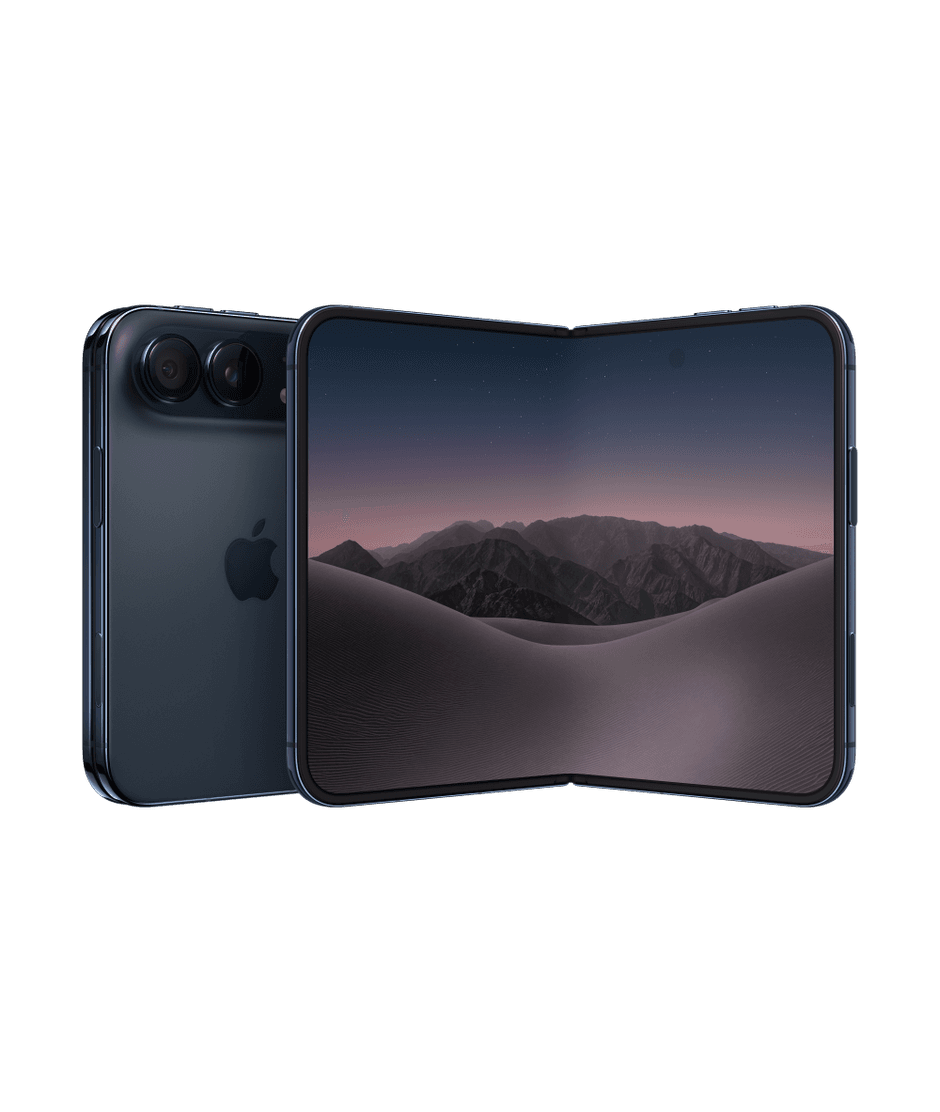
Apple iPhone Duo
Apple's first folding iPhone: a 5.4-inch outer display and a 7.6-inch screen inside, with a 48MP Dual Fusion camera and the A20 Pro chip.
- Best for
- People on iOS who want a phone that opens into a much larger screen and will pay $1,999 for it
- Key differentiator
- A folding iPhone running iOS 27, with a 7.6-inch inner display and Touch ID built into the side button rather than Face ID
Opens into a 7.6-inch screen and closes to a 5.4-inch phone, running iOS 27 on the A20 Pro chip. The trade is price and camera count: $1,999, and two rear lenses where Apple’s Pro iPhones have three. Apple opens pre-orders on 16 October 2026 and ships from 23 October.
Good fit if
- You are on iOS and want a phone that opens into a 7.6-inch screen
- You want an IP68 rating, documented to a maximum depth of 6 metres for up to 30 minutes
- You want 2TB of storage in a folding phone
Consider another option if
- $1,999 is well above what Apple’s other iPhones start at
- You want three rear cameras; this has two, with a 2x optical-quality telephoto drawn from the main sensor
- Price
- From $1,999
- Display
- Inner 7.6-inch all-screen OLED Super Retina XDR folding display, 1878 x 2670 (tall x wide) at 430 ppi, nano-texture finish; Dynamic Island, Always-On, ProMotion up to 120Hz; 3000 nits peak outdoor
- Cover display
- 5.4-inch all-screen OLED Super Retina XDR, 2034 x 1398 (tall x wide) at 460 ppi; Dynamic Island, Always-On, ProMotion up to 120Hz; 3000 nits peak outdoor
- Size and weight
- Folded 117.8 mm tall x 84.1 wide x 11.3 deep; unfolded 117.8 tall x 164.6 wide x 5.2 deep; 254 g
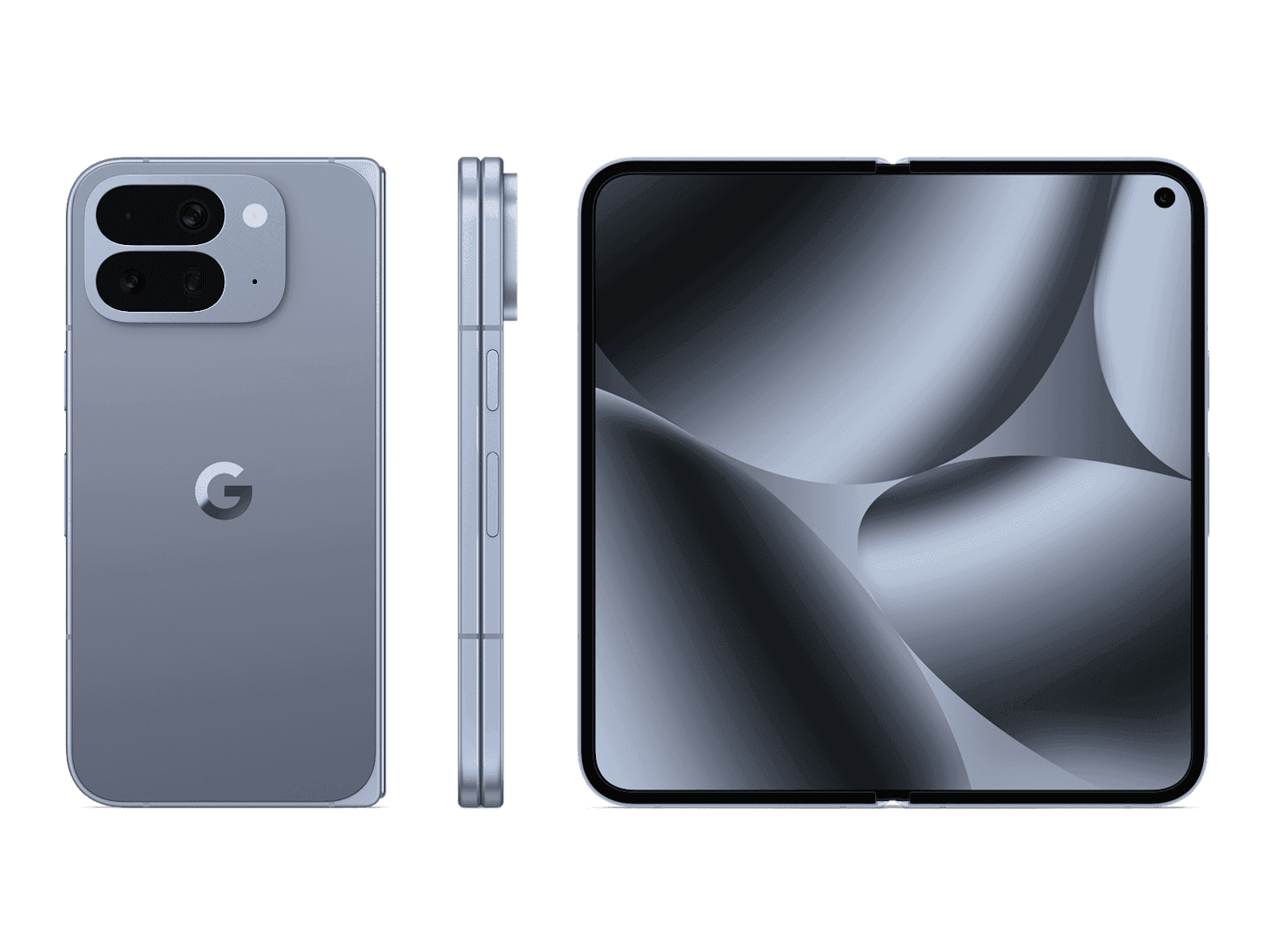
Google Pixel 10 Pro Fold
Google's book-style foldable: a 6.4-inch cover screen outside and an 8-inch screen inside, with a triple rear camera and seven years of OS, security and Pixel Drop updates.
- Best for
- People who want a phone that opens into a much larger screen, and will carry 258 g and a 10.8 mm folded body to get it
- Key differentiator
- An 8-inch inner screen and a 6.4-inch cover screen rated IP68, with seven years of OS, security and Pixel Drop updates
Opens into an 8-inch screen and closes to a 6.4-inch phone, with a 5x optical telephoto and a seven-year update commitment stated up front. The trade is bulk and price: 258 g, 10.8 mm folded, and $1,799 to start.
Good fit if
- You want a 5x optical telephoto on a folding phone
- A published update window matters: Google states seven years of OS, security and Pixel Drop updates
- You want an IP68 rating, tested under IEC standard 60529
Consider another option if
- 258 g and 10.8 mm folded is more phone than you want in a pocket
- $1,799 is well above what Google’s slab Pixels start at
- Price
- From $1,799
- Display
- Inner 8-inch Super Actua Flex OLED, 2152 x 2076 (tall x wide) at 373 ppi; Smooth Display 1-120Hz; Ultra Thin Glass; up to 1800 nits HDR and 3000 nits peak
- Cover display
- 6.4-inch Actua OLED, 2364 x 1080 (tall x wide) at 408 ppi, 20:9; Smooth Display 60-120Hz; up to 2000 nits HDR and 3000 nits peak
- Size and weight
- Folded 155.2 mm tall x 76.3 wide x 10.8 deep; unfolded 155.2 tall x 150.4 wide x 5.2 deep; 258 g
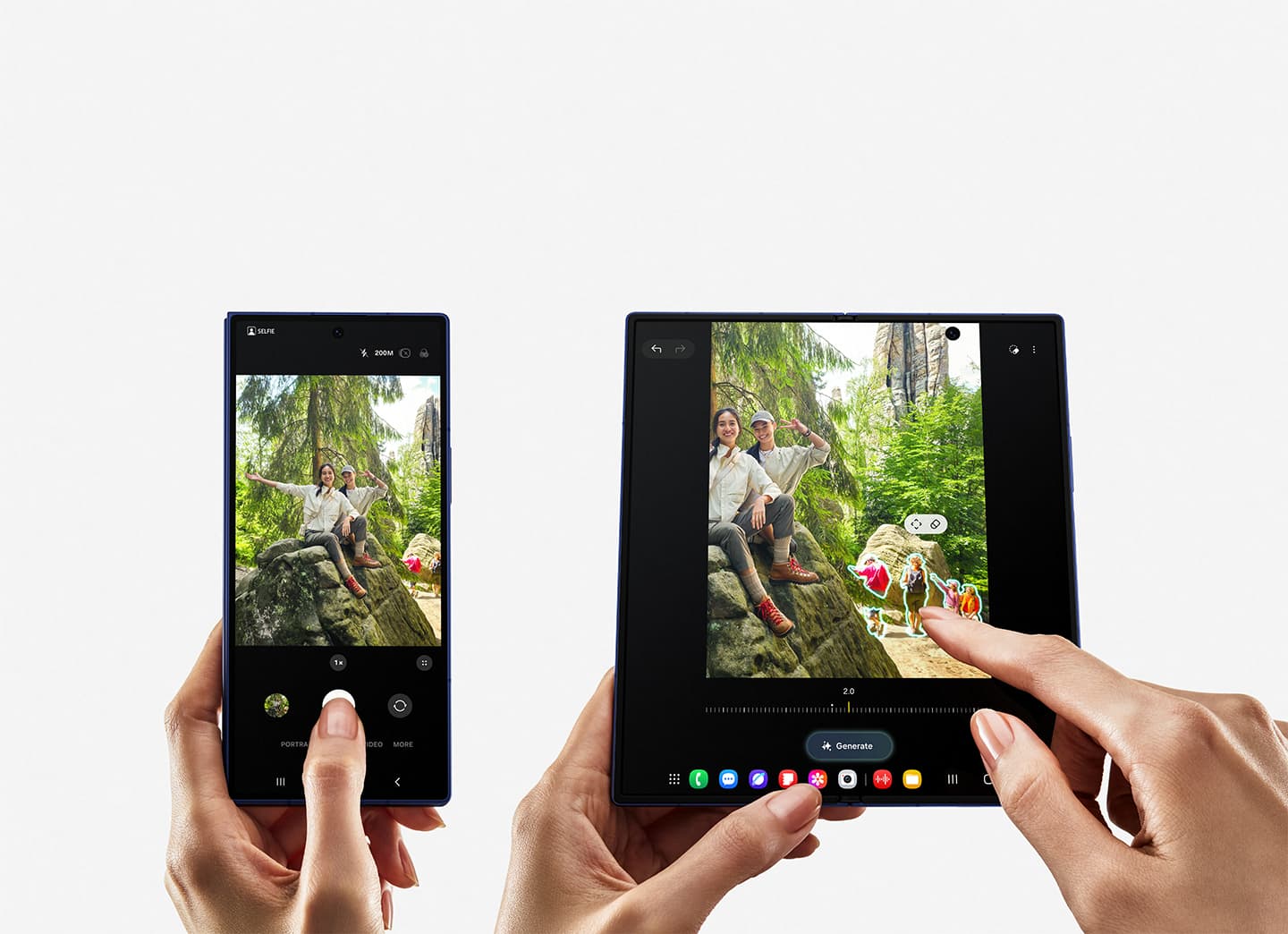
Samsung Galaxy Z Fold7
Samsung's book-style foldable: a 6.5-inch cover screen outside and an 8.0-inch screen inside, with a 200MP wide camera.
- Best for
- People who want a phone that opens into a much larger screen, and will carry 215 g and a thicker folded body to get it
- Key differentiator
- A 6.5-inch cover screen that works closed and an 8.0-inch screen inside, 8.9 mm thick folded and 4.2 mm open
Opens into an 8.0-inch screen and closes to a 6.5-inch phone you can use one-handed, with a 200MP wide camera. The trade is what folding costs: $1,999.99 to start, 215 g, and an IP48 rating rather than the IP68 Samsung gives its slab phones.
Good fit if
- You want a 200MP wide camera on a folding phone
- You want a folding phone that is 8.9 mm thick folded and weighs 215 g
- You want a narrower body when closed — 72.8 mm across folded
Consider another option if
- 215 g and 8.9 mm folded is more phone than you want in a pocket
- $1,999.99 is roughly twice what Samsung’s slab flagship starts at
- Price
- From $1,999.99 (256GB); $2,199.99 at 512GB; $2,499.99 at 1TB
- Display
- Inner 8.0-inch QXGA+ Dynamic AMOLED 2X, 2184 x 1968 (tall x wide) at 368 ppi, 120Hz adaptive refresh rate (1-120Hz)
- Cover display
- 6.5-inch FHD+ Dynamic AMOLED 2X, 2520 x 1080 (tall x wide), 21:9, at 422 ppi, 120Hz adaptive refresh rate (1-120Hz)
- Size and weight
- Folded 158.4 mm tall x 72.8 wide x 8.9 deep; unfolded 158.4 tall x 143.2 wide x 4.2 deep; 215 g
How we selected these options
Every phone here folds: a book-style foldable with a cover screen on the outside and a larger screen inside. That is the whole rule, and it describes a shape rather than passing a judgement. All three of the foldables we track meet it, so this is the entire field and not a shortlist drawn from a wider one.
The open screen is the decision
The three open into different shapes, and that is what you notice first. The iPhone Duo's 7.6-inch inner screen opens wider than it is tall, 164.6 mm across by 117.8 mm down, so it lands in landscape. The Galaxy Z Fold7's 8.0-inch screen opens taller than it is wide, 158.4 by 143.2 mm. The Pixel 10 Pro Fold's 8-inch screen is the closest to square, 155.2 by 150.4 mm. A landscape screen suits video and two apps side by side; a taller one suits reading and one app at full height. Closed, the cover screens measure 5.4 inches on the Duo, 6.4 on the Pixel and 6.5 on the Samsung, so the phone you use without opening anything is a different size on each.
Carrying one closed
Folded, the three are 11.3, 10.8 and 8.9 mm deep — Duo, Pixel, Samsung — and weigh 254, 258 and 215 g. The Z Fold7 holds the smallest number in both of those rows; it also carries the narrowest published water-resistance test of the three, which is the trade the next section is about.
Water and dust
Here the three genuinely separate, and the detail matters more than the label. The iPhone Duo and the Pixel 10 Pro Fold are both rated IP68 under IEC 60529, and Apple states a maximum depth of 6 metres for up to 30 minutes. The Galaxy Z Fold7 is rated IP48: Samsung tests it for submersion in up to 1.5 metres of fresh water for up to 30 minutes, and under that standard a first digit of 4 covers solid objects larger than 1 mm where a 6 means dust-tight. Samsung itself does not advise beach or pool use. So the honest summary is not that two of them are more waterproof: one carries both a narrower water test and a different dust classification, and its own maker tells you where not to take it.
Cameras
Sensor counts will not tell you which of these you would rather carry, and we do not treat megapixels as a measure of quality. The iPhone Duo has two rear lenses, a 48MP main and a 48MP ultra wide, and produces its 2x telephoto from the main sensor rather than from a third lens. The Pixel 10 Pro Fold and the Galaxy Z Fold7 each have three rear lenses, and their dedicated telephotos reach differently: 5x optical on the Pixel, 3x on the Samsung. What changes the pictures you can take is whether there is a telephoto lens at all and how far it reaches. All three also carry a camera on the cover and another for the inner screen; on the Duo that inner one sits under the display.
Software and how long it keeps arriving
The Duo runs iOS 27, the Pixel 10 Pro Fold launched with Android 16, and the Z Fold7 runs Android 16 with Samsung's One UI 8. Which you want is a question about the apps, accounts and devices you already own, not about which system is better, and we do not say one is. On update length we can only report what each maker publishes: Google commits explicitly to seven years of OS, security and Pixel Drop updates for the Pixel 10 Pro Fold. Apple and Samsung publish no equivalent minimum for these two phones in the sources we use, so our software support field is empty for both. That is a gap in what has been published, not evidence of a shorter life.
Battery, and why it is not compared here
We do not order these three on battery, because the published figures are not measured the same way. Apple states video and streamed-video hours separately for the outer and the inner screen, plus a typical-use figure. Google states a 24-plus-hour estimate and a cell capacity. Samsung states a capacity and a video-playback figure. Two of those print the number 24 from two different tests, which is a coincidence of wording and not a tie. Each product page carries its maker's figures in full. What can be compared directly is charging: each reaches about half in 20 to 30 minutes, though with a 60W, 30W and 25W adapter respectively.
Price and storage
The Pixel 10 Pro Fold starts at $1,799 and the iPhone Duo at $1,999. The Galaxy Z Fold7 starts at $1,999.99 for 256GB and rises to $2,199.99 at 512GB and $2,499.99 at 1TB, so the tier you actually want matters more here than the opening number. All three sell 256GB through 1TB; the Duo also offers 2TB.
A note on the iPhone Duo's availability
The iPhone Duo has been announced but is not on sale yet. Apple has said pre-orders open on 16 October 2026 and the phone is available from 23 October 2026. The other two are on sale now, so if you need a foldable this week, the Duo is not one of your options.
Why there is no ranking here
We do not number these from first to last and none of them is marked as the answer. The order on this page is our standard neutral one, by product type and then alphabetically by name, and it carries no editorial meaning at all. Nothing here is ordered by price, by availability or by what we earn.
What to weigh before you choose
Start with the shape of the open screen, because it is the reason to buy any of these rather than an ordinary phone. Then the platform you already live inside, since all three commit you to one. Then how much water resistance your life actually demands. Price comes last, and at the storage tier you want rather than the one the headline buys.
Compare these products
How we choose
Every figure on this page comes from the manufacturer's own documentation. We do not test products ourselves, we publish no ratings, and the options above are not ordered from best to worst — read how we evaluate products, or browse the full phones category.